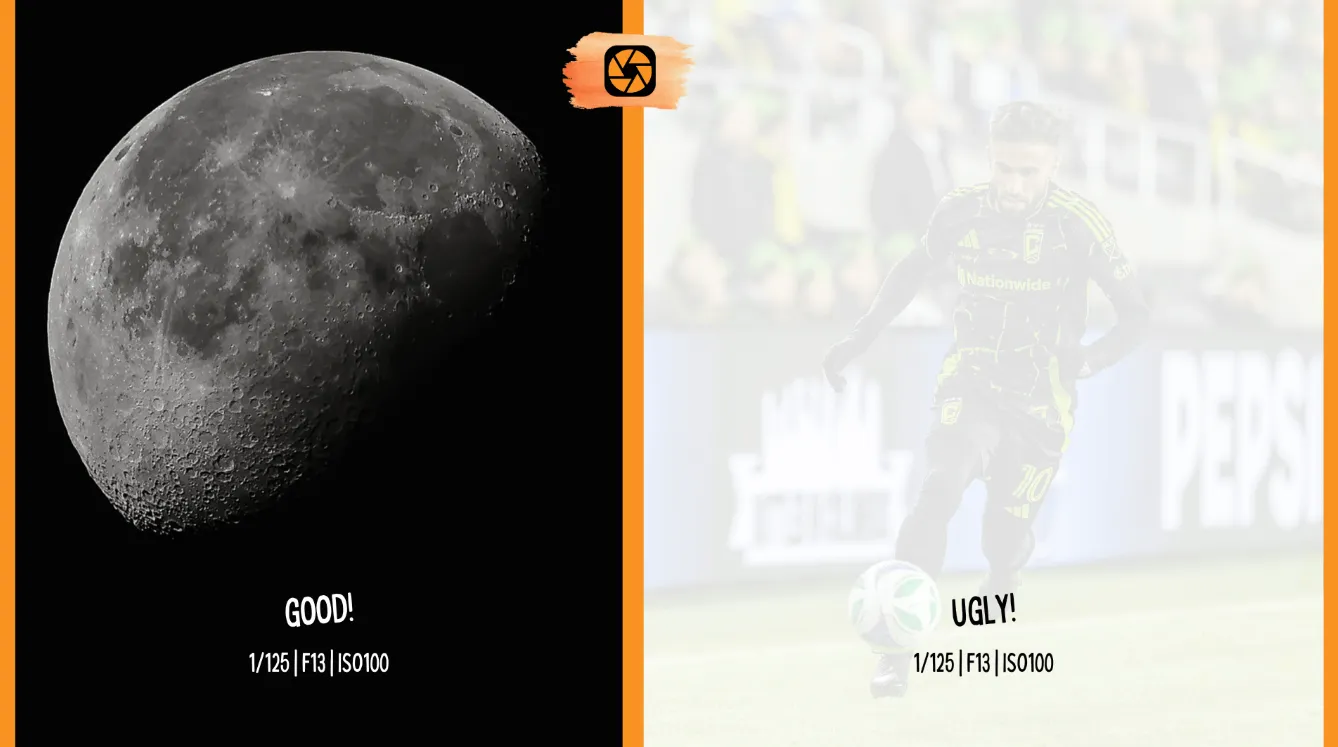
Shutter speed is one of the three settings that controls every photograph ever taken, and one of the most common sources of ruined shots for beginner and experienced photographers alike. This lesson covers what shutter speed actually controls, why it’s a creative decision that has to match your scene before you press the shutter, and what happens when a professional photographer shoots a Columbus Crew game the night after shooting the moon and forgets to check his settings.
If you worked through Lesson 1, you already understand aperture and how f-stops shape light and depth of field. Today we’re adding the second control: time.
The Moment
On a recent night in Columbus, Ohio. The Crew were on the ball, the whistle had just chirped, the stadium lights were burning bright, and I had my camera up and ready. First burst of the night. I squeezed the shutter and the camera fired, once. One frame. Almost completely white.
Not overexposed. Not slightly blown out. Almost a total white out. Like I’d pointed my lens directly into the sun.
I knew immediately what happened. I just didn’t want to admit it.
The Real Problem
The night before, I’d been shooting the moon. (If you’ve never tried it, lunar photography is one of the more satisfying things you can do with a camera; patient, deliberate, quiet. Highly recommend!) Anyway, I captured the shot on the top left from the end of my driveway off a tripod. My settings were dialed in for exactly that shot: 1/125th of a second, single shot mode, aperture and ISO tuned for a bright object against a dark sky.
And then I showed up to a professional soccer game the next night and never checked settings. Very unprofessional.
The camera remembered my last settings. I forgot.
Shutter speed at 1/125th under stadium lights with a wide open aperture is a recipe for one thing: a completely overexposed frame. For soccer, I typically shoot 1/2000th, or 1/2500th under professional stadium lighting to freeze a player at full sprint. That’s not a preference. That’s physics.
The Fix — How Shutter Speed Controls Motion and Light
Shutter speed controls how long the shutter is open and how much light your camera’s sensor is exposed to. A fast shutter at 1/2000th of a second opens and closes so quickly that motion freezes. A slow shutter 1/125th of a second stays open long enough to let movement blur, or in my case, let so much stadium light pour in that the image disappears almost entirely in a white out.
This is why shutter speed isn’t just a technical setting.
It’s a creative and practical decision that has to match what your scene actually requires. A sprinting midfielder and a full moon are obviously not the same subject. And they most definitely don’t get the same settings. They require decisions before you shoot. Decisions that up to now, if you’ve been shooting in Auto, the camera is making.
The fix isn’t complicated: before you shoot, check your settings. Know what your scene requires. Set your shutter speed to match the desired effect. Then shoot.
The Sideline Lesson
Manual mode gives you control. But control only works when you’re actively making decisions.
This is something I teach my students (and apparently still have to teach myself sometimes) the camera will do exactly what you tell it to do. If you tell it 1/125, it shoots at 1/125. No warning. No second-guessing. No “hey, are you sure about that?” The camera is not your editor. It’s your instrument.
That evening in Columbus was a reminder that mindfulness isn’t a soft concept; it’s a good photographer habit. The difference between a photographer who owns their camera and one who just carries it around is this: know what the scene requires, and sets it correctly before they press the shutter.
Scene awareness. Setting awareness. In that order, every time.
The Takeaway
Manual mode puts you in control. But control without mindfulness is just expensive guessing.
In the Lab
Try this: Before your next shoot, any shoot, stop for ten seconds. Ask yourself one question: what does this scene actually require? Motion or stillness? Speed or light? Then set your shutter speed to match the answer. Write it down if you have to. Check it before you raise the camera.
That habit is the difference between owning your camera and letting it own you.
Trust it. Trust yourself.
—TMac #shooton
