Jeff Alberini — Media Education, Demo Reels & What It Actually Takes to Get Hired
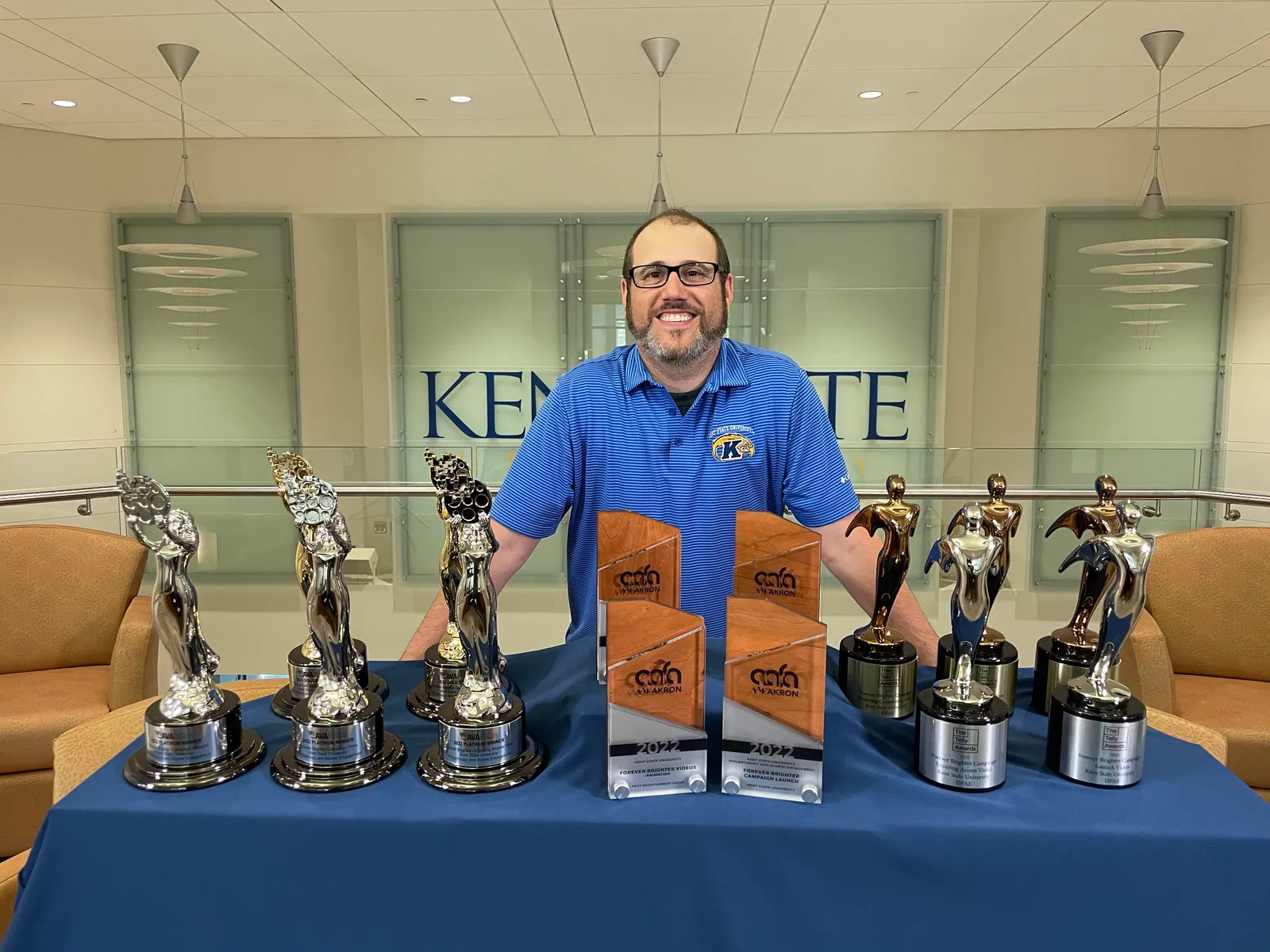
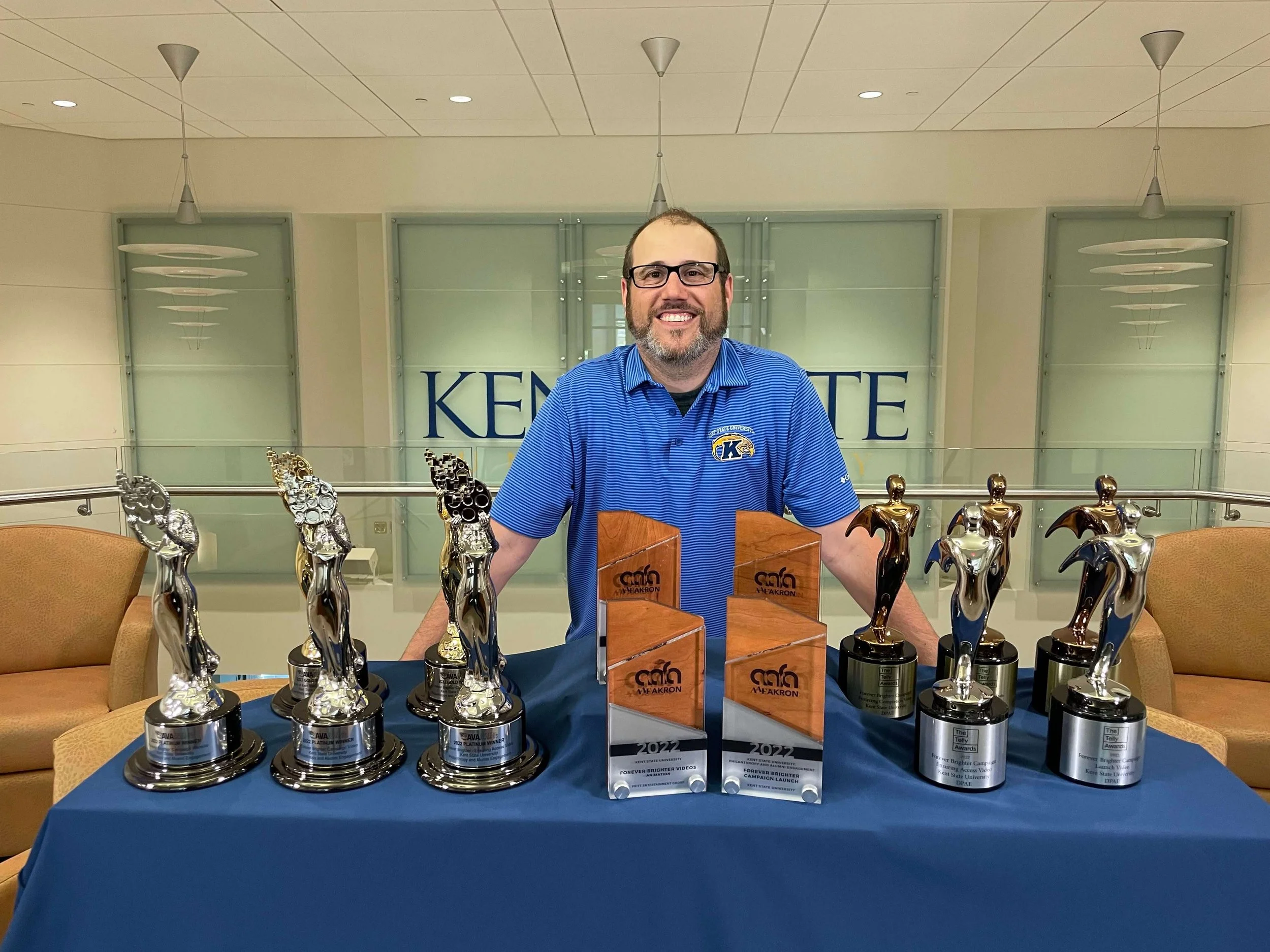
The hardware tells the story. Jeff Alberini and the awards that followed 20-plus years of staying curious. Photo Credit: Jeff Alberini. Used with permission.
Jeff Alberini thought he was going to be an accountant. One video production class at Kent State University changed everything, and twenty-plus years later he’s leading media production for Kent State’s philanthropic and development operations, telling stories that move donors and raise scholarship money for the next generation of students.
In this episode Jeff and TMac, two Kent State grads from the same M.Ed. cohort, compare notes on media careers, passion projects, and what Jeff looks for when he’s sitting on the interviewer’s side of the table.
Why It Matters
Jeff’s three things for any aspiring media professional, research the position, build a custom demo reel, prove you’re willing to learn, aren’t just interview tips. They’re career philosophy. Nobody knows everything 20 years in. The ones who last are the ones who stay curious and adapt. For anyone preparing to walk into their first production job interview, this episode is the prep session most people never get.
About This Guest
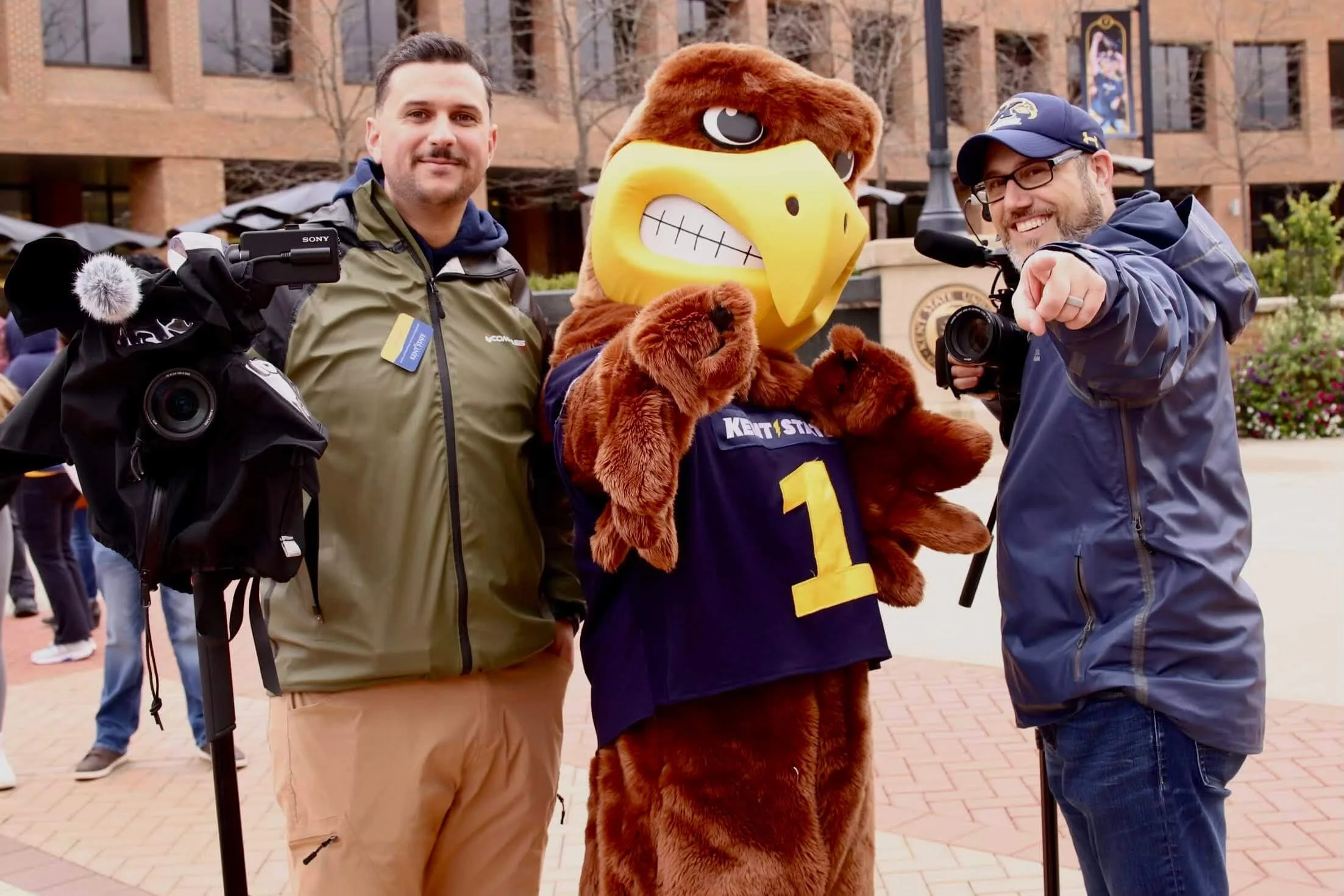
Jeff Alberini is a media producer and storyteller at Kent State University, currently leading video and digital content for the university’s philanthropic and development operations. A Kent State undergrad and M.Ed. graduate, his career has taken him through TV2, teleproductions, PBS work, Hiram College, and multiple stops in higher education media before returning to his alma mater. He’s an award-winning executive producer whose work on Kent State’s Forever Brighter campaign earned multiple CIVA and educational advertising awards, including recognition for a live homecoming parade stream built almost entirely on student talent.
Jeff’s Bonafides
“
Nobody knows everything. I don’t know everything and I’m 20-plus years into this career. What you have to prove in an interview is that you’re willing to learn and willing to adapt. Technology and software will continually change, but if you have a strong foundation, you can continue to achieve everything you want in this production world.
”— JEFF ALBERINI, KENT STATE UNIVERSITYHear This Episode
Watch Here
Episode Timestamps
Your ZoomPod — Exit Ticket
After this episode, you'll know:
- Why a custom demo reel built specifically for the job description beats a generic showreel every time
- What hiring managers actually read in cover letters and why cookie-cutter ones get spotted immediately
- How listening skills matter as much as speaking skills in both live production and job interviews
- Why proving you’re willing to learn outweighs proving what you already know in any media job interview
Gear & Affiliate Links
Trick out your kit, and your wardrobe. Both Adorama and SmallRig are having sales right now. Or wear your photography mood, grab a ZWOF set-wear tee shirt. If you use a ZWOF link, we may earn a small commission that doesn’t increase the price of your item.
Explore More
Check out our other great podcast episodes. Link and follow for more great learn-photography content: IG @zoomwithourfeet | FB @ZoomWithOurFeet.
Jeff built his career by staying curious and adapting every time the technology changed. Same instinct belongs behind every camera.
Stop Shooting From the Stands →TMac 00:11
Hello and welcome to another edition of the Zoom with our feet podcast, the pod about creative production. With me, your host, TMac, a professional photographer, videographer, and teacher. On this episode of the Zoom Pod, Jeff Alberini, a fellow Kent State Media and Education grad, joins me to share invaluable insights about media education, the ins and outs of passion projects, and the best advice for aspiring creators. Let’s talk to a pro. Jeff Alberini, welcome to the Zoom with our feet podcast. How are you? I’m doing good. How are you? I am great. I’m great. It’s great to have you. This is the All Kent State episode of the Zoom Pod. Both Jeff and I have undergrads from Kent State, and also, we’ll talk about it later, MEDs. Same cohort.
Jeff 01:28
Yeah.
TMac 01:28
I went all educational on you for that one. We will talk about our educational experiences in a minute, but I’m really interested in your in your media experience, media production specifically experience, and how you’ve you’ve brought that to the industry back again. So let’s get into it. How did your production journey start?
Jeff 01:57
My production journey started when I stumbled upon a class during my undergrad at Kent State University. I did not go to college in the beginning for this. I’m s it sickens me to have to say I thought I was gonna be an accountant. That’s what I went for, and I took a few classes, and I’m like, eh, I’m good at numbers, but this is really not my thing. But you know, I gotta I gotta give a lot of credit to my dad. My dad’s a real movie buff, he watches a lot of films. You know, and when I was growing up, there were no parental ratings or anything. So I grew up watching everything right along with my dad, whether it was TV or films. And then once I realized that Kent State actually had a major for video production and I took my first class, I was I was hooked. I was hooked. But you know, from there it just kind of I started working at teleproductions and I also worked at TV2. Those are TV2 is a student-run organization. They do newscasts and other shows. I was a news, I started out as a camera, but yeah, I did news directing and technical directing. That was kind of my jam. And then I got into some PBS shows with teleproductions. And I did news night acron for several years. So imagine being in college and spending, you know, your first three hours of a Friday night filming a TV show in a in a studio in the first floor of music and speech. Wow.
TMac 03:46
And the experience and all of that. That’s you know, I actually worked in before Black Scroll Black Squirrel Radio, there was a WKSU. I did a night I did a night shift. I used to dedicate records to the desk, young lady at the desk at Prentice Hall, who’s now upstairs. Nice, yeah. Is gonna date you, so I’m gonna ask it. It’s okay. First video camera that was yours, and what did you use to shoot with it?
Jeff 04:31
Oh geez. The first video camera, professional one that I bought was right when I graduated. It was a Canon GL2 and it shot on mini DV tape.
TMac 04:46
Tape.
Jeff 04:48
Tape, yeah. So I learned linear editing, tape to tape while at TV2. That’s how we cut all of our stuff for news. I remember my first short film I ever did at Kent State. They had a product called a video toaster, and the video toaster was extra transitions beyond a cut, a dissolve, or your standard wipe. So that were that’s where all like the DVE effects were in this thing called a video toaster.
TMac 05:19
The toaster.
Jeff 05:21
Yeah, yeah, that dates me too.
TMac 05:24
Well, I’m gonna go a little further back. I learned on BVU 800 three-quarter inch decks, and for the young bloods out there, editing was copying from the source to a record. That’s it. You told it when and what channels, and you hit a button and it went back five seconds, pre-roll, went up to that point, and then started copying.
Jeff 05:56
Yeah, that’s that’s it. That was editing. That was it. I don’t think I took my first nonlinear editing class until I was a junior. I think I learned on like Adobe Premiere, I think it was like four. It was really old. And then my last year Final Cut Pro came out, so I’d already taken my nonlinear editing class, and as a lifelong learner, even at that age, I taught myself that program. And then I was a final cut editor for probably a decade before I jumped back to premiere. And that’s what I’m still cutting with now.
TMac 06:38
Final Cut 7.
Jeff 06:39
Final Cut 7. That when I say I’m a Final Cut editor, that’s what I meant. I when it once it went to X, it was like, I can’t do this. This is too much like a novice editing system. Didn’t have all the things that I was used to.
TMac 06:55
IMovie on steroids. That’s exactly what it was.
Jeff 06:59
Yeah, exactly.
TMac 07:01
Who did you I mean you’ve done it all, but when you first started, was it camera that really that experience? Was were you really focusing on camera or were you anything and everything?
Jeff 07:18
You know, when I first started, you had to work your way up to camera, okay? So camera ops normally were reserved as upperclassmen spots. So, you know, I started as a floor director, or I ran audio or I ran graphics. So the way Kent State kind of had it set up is probably how my professional career kind of developed, is I was learning all these different crew positions on live productions. And then once I got my shot, I was able to do what I wanted to do, which ultimately was be a technical director. But that’s why I did both. TV2 allowed me to direct and TD, where for the PBS shows, the highest you could go was camera. And camera one for News Night Akron, that was the cool camera because you got to do the push at the opening shot. And where everybody else, it was like two shots and solos. So, you know, at least you got to do some camera movements from camera one. Little easy zoom. Easy zoom. Yeah, yeah. It’s a skill for sure, for sure, as you know, as you know.
TMac 08:40
Specific to camera, how did you and lifelong learner? Did you teach yourself the basic basics of camera operation exposure, iris, framing and comp? How were you was there classes then?
Jeff 09:03
Yeah, there were classes then, yeah. So this was like 99, early 2000. I graduated with my bachelor’s in 2002. So my first class was intro to video production. You know, you check out one of the ENG cameras that they had. And although they kind of went over the basics, you’ve got to imagine a professor standing in front of the room with one camera and some projected slides behind them of some buttons. So if you really wanted to learn it, you had to teach yourself. Because there weren’t online manuals like there are today. We didn’t have that many resources. So it was, you know, like roll your sleeves up and go and film as much as you could. So you know, you would do it for all your class projects, but at the same time, you know, you were trying to film a lot on your own time. And you know, I was lucky enough that I was working a part-time job while I was going to school at Circuit City, also dates me. This is an electronic store back in the day. Dead. Yeah. I was able to buy a smaller, like consumer video camera that I could just film. And that was mainly just for shot composition. Because to me, when you’re learning how to use a camera, it doesn’t matter what brand the camera is, it doesn’t matter what kind of lens is on it. If you can’t compose a shot, it’s really hard to get a job in this industry. So I always laugh whenever I’ve interviewed for video positions throughout the year. People ask me, like, well, what cameras do you use? And my answer is very similar to what I just said. Doesn’t matter what camera I use, I know how to frame a shot using the rule of thirds, and based on that knowledge, I can figure out where all the buttons are probably in about 10 minutes from there.
TMac 11:14
So it’s the technique, not the technology.
Jeff 11:20
That’s right. That’s right. The technology can advance as much as and it’s it’s amazing technology now compared to when I started, but the technique is still the same. You know, you’re still I guess the one advantage these I would say students nowadays has is they can actually turn a button on that puts the roll of thirds on their EVF or like flip out L C D.
TMac 11:49
Yeah.
Jeff 11:49
When we were learning, it was in your head, and I think that’s the advantage. You know, I was constantly seeing that lack for lack of a better term, tic-tac-toe board over top of everyone’s face. That way I knew, okay, if I’m filming an interview and my interviewer’s on this side, I want to make sure I leave the lead room on this side, or if you know I’m doing like a moving shot, I get to decide as the camera operator, do I leave the lead room or do I come around behind them and follow them? But while you’re doing it, you know, it’s it’s if you can’t compose a still image, it’s very hard to compose some something moving.
TMac 12:32
All right, so 2002. Newly minted BA in electronic media production. Now what?
Jeff 12:43
Oh boy. Well, I did an internship at a production house in Medina. I don’t think they’re in business anymore. It was creative technology, they had a really good DP there, like the cinematographer I learned a lot from. I also learned how to a lot of lighting techniques from them. I remember my first day, even interning there, they were like, Yeah, go out to the truck and get a couple of C stands, get some, you know, some boom arms, a couple of knuckles. They started naming all this random stuff, and you’re like, what? Like, I so just learning all the terminology was key. But when I graduated, I freelance with them, and I did that for a couple of years. While I was doing that, I was also trying to do my own thing with one of my best friends in town. You know, we were taking any video gig that we could get, whether it’s wedding videography, I dipped my toes in that, commercials, public service announcements for nonprofits. We tried a lot of things. And you know, like I said, several years do did go by. I also tried my hand at filmmaking, you know, as somebody that watched film as much as I did when growing up, you know, I wrote a short script and I got all my friends together and we filmed it over several weeks. I would never show anybody that now, and anybody who has a copy of it, I hope it doesn’t work because it was really bad. But I’ll be honest, that’s how you learn. You can’t learn how to do anything unless you do it. So but yeah, and then a teaching job opened up and in Youngstown, Ohio. The school was Chaffin Career and Technical Center, and so this was the career center for Youngstown City Schools, and it was unique because most career centers, there’s one per county, and but Shaffin was created during segregation to have a specific career center just for the underprivileged population, and it was it was great to work there, it really was. And I learned from a lot of great vet teachers. They took me under my w under their wings, and lots of people in the community call it Schaufen, and it really irks me to this day when I hear it, even in a commercial, because it was a person’s name, you know, it was their last name, Shofen. So you know it’s important to say it correctly. But yeah, I taught there for 10 years, and during that time is when I met you. We did our master’s degree together at Kent State University, and we were what was considered to be Route B teachers. So Route A is you know, you’re in college for your undergrad, and then you have to do your student teaching. It’s the normal way. Route B teachers is we have a specific trade or skill set, and that knowledge is what we teach. And you had to have that knowledge in order to qualify for the position, but there was a catch. The catch was you had to go back and get your teaching certificate, and that’s where we met.
TMac 16:33
We did, yeah. Guys finding each other in the back of the classroom going, what are you in for?
Jeff 16:41
It’s pretty much it, you know. Who was who else was in there? Brian Odell. You remember Brian? Oh, yeah. Yeah, so Brian is how I got that job. Well, the interview. Brian taught at this high school that I graduated from, Halland High School here in Warren, Ohio. And after I graduated, I saw a bunch of stuff in the newspaper. You know, I was still the principal lived a few streets away from my parents. And that film I was telling you about, there was an article in the paper. Hey, local, you know, filmmaker, this or that. Well, they saw it and they had me come in and talk to the class. And, you know, I met Brian and he was telling me, hey, you know, there’s a lot of career centers or high schools that have career programs that are trying to start this new multimedia class. And he let me know about the Youngstown City job, and I found the posting and I applied. And I’m gonna be honest, I only anticipated that I would work there two years, three tops with one goal. The goal is I want to get into education, I wanted to start my own program, and eventually I wanted to be a faculty member at a university. That was my goal, and I made that goal when I was 22, sitting in the back of a senior level class, because I knew that my father was working 60 to 70 hours a week just so that he could help me get my education. And I thought to myself, all right, I’m going into video production. I’m not gonna make a ton of money, probably. I’m gonna make enough to have a good life. But if I have kids, I’m probably not gonna have the opportunity my dad did, just to keep punching over time, you know, stay at the same shift, make time and a half, those kinds of jobs, they’re they’re really not there anymore. And knowing that tuition benefit was there for faculty and staff as an employee, it was a big selling point, and it’s something that I chose way back when.
TMac 19:08
So we’re talking career tech ed. Yeah, it wasn’t it was it’s had many variations throughout the years. What was the most rewarding thing about teaching? And what was the most difficult thing for you teaching? Sure.
Jeff 19:31
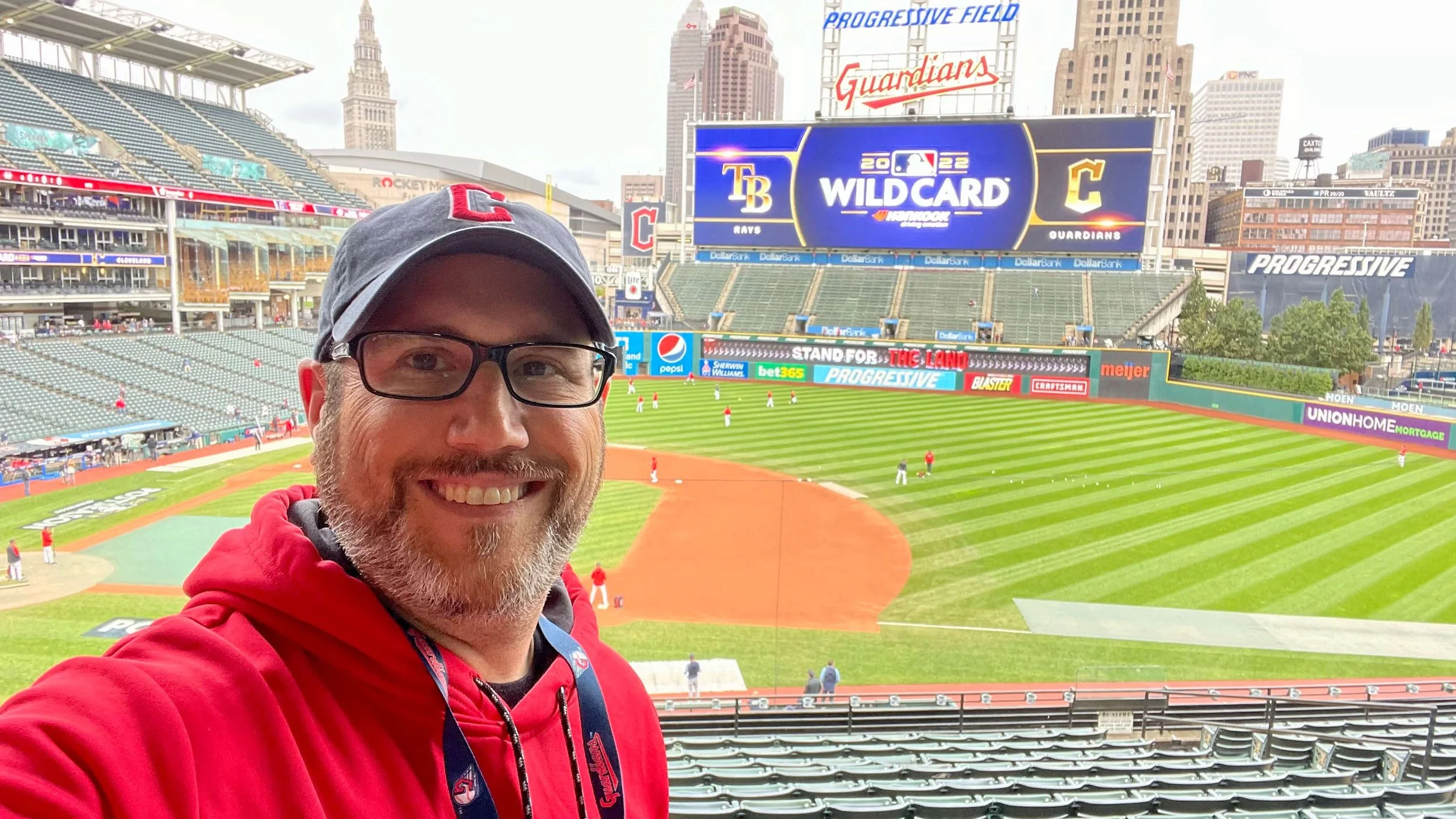
The most rewarding thing in my teaching career was when I started to get some alums of the program and they went out and they got jobs in the industry that I taught them. Those success stories are what kept me going. You know, I tell everybody if you’re gonna take risks, do it while you’re young, because as soon as you get a full-time gig that gives you a little bit of cushion, you get a little bit soft and life happens. And that’s what happened. You know, I met my wife, and before I knew it, we were starting a life together, and then it got harder to get out of teaching. Not that I wanted to get out, but again, the goal was two, three years. But I was enjoying it so much. It was so rewarding to watch these students take these skills because it’s not, I’m not downplaying regular academics, okay, but there is just something about the way that our career tech programs are built, they’re built with about 45 minutes related, and the rest of your you know, hour and a half, two-hour block, that’s where the money happens because that’s where you’re teaching them those hands-on skills, and it is how the health industry works, and a lot of career tech programs and career tech schools modeled a lot of it after that, and it was great. That was so that was the most rewarding thing. You know, I got I have students that work at Fox 8 News, or you know, I had students that won art awards. I teach video, but you know, they learn Photoshop from me because we were creating graphics, and you know, I had a student win a Heinz Ketchup design contest as a national contest, you know. We got to go to the state house and she got an award and everything. So those moments are their most rewarding, and my fellow teachers, they were like family, you know. It’s the cool thing about that job was every single person that worked there had a completely different trade. So you knew plumbers, electricians, masons. You know, and then there’s me. I’m in like this IT field. That’s what they viewed it as. Oh, well, he teaches video multimedia. He must know a lot about technology. But we could all kind of help each other’s families with the services that we knew. So, you know, I remember having the first shed that I had built when my wife Chris and I bought our first house was my buddy Kevin, you know, he was the construction teacher and he came over on a Saturday and helped build this shed, you know. So, and I remember going over people’s houses and setting up, you know, wireless networks and you know, taking pictures or doing wedding videos or whatever, whatever, you know, but it was a cool thing. It was a cool thing. What was the most what was the hardest thing about teaching? Teaching in the beginning, like the first five years was pure teaching. My last five years, a lot of things changed in the state, and I ended up doing more paperwork to prove that I was teaching than I was actually teaching. And, you know, that part was, you know, it’s it’s necessary as a teacher, you know, to have documentation, to have a curriculum and to follow it. I understand all that, but again, like we’re teaching skills. Like the skills I was teaching, it wasn’t changing, but all the work that I had to prove that I was teaching those skills changed. And then you know, teaching in Youngstown City, you know, I there was a few tragedies that had happened in my 10 years, and I had I had a great student. You know, love that kid. He would just he ended up getting murdered. It’s still an unsolved case to this day. Complete nonsense, wrong place, wrong time, beautiful soul. I don’t know. I kind of didn’t come back from that one. That one was hard. I’m still not over it, but that was one of the things that kind of hedged me towards getting out of teaching. But the beautiful thing about while I was teaching was I was working in the industry the entire time. So I didn’t just quit video production. I was still making films and I was working for then the Cleveland Indians, kind of like working my way through the ranks, just like I did at teleproductions and TV too, starting out as a field producer, doing some audio, and then being able to get my shot at being a technical director there. But yeah, it was a great 10 years. It was a great 10 years.
TMac 24:48
I feel for you, brother. I’m so sorry. It is I’ve had students get thrown out of the house. I had one of my best students of all time could have gone off and don’t he was doing it at that level in the program and he was being groomed for the family business. And it was and it was just heartbreaking to you know, to just sort of see that potential. You know, he’s married, got kids now, and perfectly fine. And every once in a while when I have contact with him, I go, You making company videos? Yeah, yeah. I’m sorry, brother. It’s okay, you know, it happens. So that as you ease out of education, you had been laying the groundwork for making a transition back to the industry. How did that happen next?
Jeff 26:12
So, you know, I what ended up happening was is my wife was pregnant with our twins, and you know, some things were happening in the district, like I said, you know, like that tragedy happens. I don’t know, you just start taking a close look in the mirror. Is what I’m doing every day what I set out to do? And the answer was no. The answer was I set out to do two to three years, I’m on year 10. I could easily see myself being here another 10 and watching kind of the rest of my life right there not go as I kind of wanted it to. So I took a leap of faith. I took the exact same leap of faith that I took on my education, just getting out of teaching. So you know, taking out all those student loans to get my undergraduate that leap of faith there, I believed in myself, I believed in my skill set, and I took that same all the skills that I had learned and then I’d been teaching, and I decided to just go get paid for it and not teach. So the next couple of years, mainly just all sports production. And again, that doesn’t happen unless I was a student at Kent State. And the reason is my senior year at Kent State kind of caught lightning on a bottle with the basketball teams. There’s a group of us that went to you know, the staff members at teleproductions and said, Hey, you know, we know you’ve let students in the past do a hockey game or a baseball game or a basketball game in the, you know, in the past. Is there any way we can do a basketball game or two? And you know, they said, Yeah, sure, we’ll try it out. They didn’t think it was gonna be a thing. And we ended up directing over, or I ended up being directing over 22 men’s and women’s basketball games. 2002 was the year that Kent State went to the Elite Eight. This is the year that, you know, everything that the foundation of Kent State’s basketball program created by Gary Waters, this is where it came to fruition. And it was a great ride. And the funniest thing about it is everyone always asked me, what was it like going to all those games? And that’s when I knew that I loved working in sports production because I didn’t go as a fan. I was in the corner of the Mac Center with a little remote box with a slide-out switcher, and I had an audio operator next to me. We had what do we have? One, two, three, four camera operators. Yes, you had game, two baseline, and a tight follow. And everything else was fiber back to the studio in music and speech. They overlaid all the graphics, they did the score bug, they ran all the commercials. So there was a director there as well. You know, they did pregame, post-game, and halftime shows. So, you know, there’s a group of, I would say, I don’t know, 15, 20 students that got the experience of a lifetime, and that really laid the foundation for me to get into sports production. And that’s when I was hired at Cleveland Indians, I think that was like 2008. So I was a few years into teaching, and at that time, I mean, I’m working 75 games a year while teaching. It was a lot, but you know, you’re young and you know, you can run on all not a lot of sleep. But when I got out of teaching, then I just I just worked games, so it didn’t matter if it was high school football, high school basketball, you know, major league baseball. And then I also got into the Canton charge. So at that time, the Canton Charge, well, the MBA, we were subcontractors through the NBA, and my job was the instant replay operator, and the main reason why they added that crew position was to help train MBA referees. So, you know, like that’s when they go to the table. Yeah, so it’s like a dual job. You’re running replays for the stream or broadcasts, but then if a ref goes and says, Hey, we need to see this time to see if it’s a three-pointer, we’d re-rack everything and show it to them from every angle we had, and it’s slow motion just so that they could make the call. So, you know, it was it was a cool gig.
TMac 31:12
And that was the civic center in Canton.
Jeff 31:16
Yeah, yeah. So again, I live in Warren, Ohio. It’s not too far away from Canton and Cleveland and Akron, and I went all over northeast Ohio doing sports direction.
TMac 31:27
You were driving right past my house.
Jeff 31:30
Yeah, yeah, yeah.
TMac 31:31
Okay, so education to industry. Transition back to education, right?
Jeff 31:41
Yeah, I did. I did. Before that, I while I was teaching, I did a feature-length documentary. So yes, it’s kind of an important part of my journey because you know it shows the diversity of cameras and equipment that you need to know to be able to do things like this.
TMac 32:05
Single camera versus live multi.
Jeff 32:08
Right, right. And you know, you’re having to set up your own lights versus being in an arena and it’s already lit. You know, you got to be able to set up and record clean audio. And on that feature film, the director’s name was Eric Murphy. We met up again when I was doing that film I was telling you about, names in the paper, it led to the teaching job, and it led to my first short film, which was his graduate thesis film. And probably about two years after that, he got a hold of me and he’s like, Hey, I want to do a documentary on Jim Traffkin. And for those of you that don’t know who Jim Trafficant is, Jim Trafkin used to be our congressman here in the Mahonan County. And I’m in Trumbull County, but he was probably one of the most bombastic in-your-face politicians, and this is all pre politics of today, because now there’s a lot of characters, but everyone was really straight-laced during the trafficking area era, and it was him. He stuck out like a sore thumb because he wore bell bottoms, and his hair looked like wild hair, wild hair, it looked like he got cut with a weed whacker, you know. But we so I shot and lit over 20 interviews in probably about a three, four year span. So again, times were way different during then. HD had just started, so now you’re teaching yourself a completely different skill set because you go from mini DV tape and now you’re not on tape anymore, you’re on SD cards.
TMac 33:59
I was just gonna say you were file-based for that.
Jeff 34:03
Yeah, we were file-based, and Google Drive is really what we used. So Eric was living in Los Angeles. He’s a writer-producer, you know, just look up Ancient Aliens. I mean, he’s done almost the entire series. He’s really talented at what he does, but he wanted to do something about home. And so he flew home a couple of times, and you know, we spent you know, months filming. When Jim Traffic got out of jail, we followed him from when he got out of jail and on the campaign trail, because you know, he ran again when he got out, and he was at we went to every single event. And then we thought we were done with that. Like the film was wrapping up, and then unfortunately, Jim Trafkin had that horrific accident on his farm where his tractor flipped and crushed him. I was it was awful. Well, what an awful way for any human being to go out, but we had to reopen the edit and do more interviews just because we couldn’t leave it out and do like an epilogue. Yeah, we and we had to, you know, like how do you do a documentary on somebody and release it without that portion of it? Yeah, so that extended it. I mean, this is a seven-year passion project. You know, like I said, the media was different than I went to school for. You know, when I started that film, you know, I’m cinematographer, I’m the lighter, I’m the audio guy, and it’s me and him. We’re just going to people’s houses or places of work and showing up and doing what we do, you know, walking through a space, checking the get the right angle, close your eyes, listen, what needs turned off, you know, all the things that you need to figure out how to do to light an interview correctly.
TMac 36:13
Record a couple of minutes of room sound for the edit.
Jeff 36:17
Gotta have that wild track, man. Gotta have it.
TMac 36:21
Okay. So how long was that period?
Jeff 36:24
That was a seven-year period while I was teaching. So it started almost at the same time I started in Major League Baseball. And it was 2015, is when it played at the Cleveland International Film Festival.
TMac 36:43
So how did the transition you were like Mr. Transition? Yeah. How did the transition back to the mothership of Kent State come along?
Jeff 37:01
Oh, wow. Well, I had a few stops in between that and Kent State. You know, I worked at an advertising agency in Youngstown, Ohio for a few years. And the reason why I wanted to dip my toes into that is as I had done so much in secondary education, higher education, you know, even while I was teaching, I got hired in as like an associate producer on their Emmy nominated show, Homework Express, you know, working with their students, which ended up being a lot of my students that had graduated and just went across the street to Youngstown State. I remember Dr. Owens, he’s head of the program. I was second-year teaching, and they started asking us, hey, we need to start building these pathways so high school students can get college credit. So I set up this big meeting at Youngstown State, and I’m sitting there, and there’s all these tenure professors. Dr. Owens walks in, he’s got his hat on, takes it off, and he like looks at me and he’s like, So you want us to give free college credit to your students? And who are you? And that’s the truth. I was like 25, you know, like I get it from their perspective now. I completely understand how ridiculous that sounded. But fast forward two more years, then they’re calling me because they have my students now, and they’re like, hey, these students know what they’re talking about because I instilled that work ethic in them. I gave them the soft skills, you know, like the hard skills, everything. And that’s when that connection happened for me to go and work with them. But I wanted to do the advertising agency just because I wanted some business-to-business experience, you know. So I did web design, logo design, print layout, and video production. And I didn’t go to school for any of those other software programs, but as a lifelong learner, you just keep teaching yourself. So I’ve taught myself a lot of those things. And then I worked at Hyram College for almost three years, and at Hiram, I was working with the alumni department, and they had a 24-hour day of giving. And you know, I pitched them on some ideas to do some giving videos to try to help drive some social media donations, and those videos are the reason why I got my job at Kent State. You know, I saw the posting. It and I work in the philanthropy and alumni engagement division at Kent State University, so it’s in a building that wasn’t there when we were there. It’s the one on the corner of Lincoln and Summit. That’s pretty funny. And now the rewarding part about that job is we get to help raise scholarship money for students to be able to get an education at our alma mater. We get to help raise money for capital projects, like the new Crawford Hall for the business school. I mean, that is changing the landscape of Maine and Midway. You know, like the airport change recently, you know, FedEx was a huge sponsor. The engineering school, you know, so air tech I was gonna say aeronautics and engineering, they outgrew their building and they had to put on and expand. So, you know, we’re part of those projects, and then you know, we’re part of the alumni engagement. So getting people involved in homecoming.
TMac 40:59
Oh, go ahead.
Jeff 41:00
I was gonna say, so the official title is Oh, I’m the senior associate director for video and digital outreach in the communications department in the division of philanthropy and alumni engagement. It’s mouthful.
TMac 41:18
So here’s the point I want to kind of tie together is at every stop as you transitioned back, industry and back sometimes, duality of industry and teaching and education, the ad gig, all of that. When you look back, you say I now am most effective at my current job because of one, two, three, four, you know, half a dozen stops doing different aspects of it.
Jeff 42:01
Yeah, doing different aspects for sure. And you know, again, to be in the video production industry, whether it’s live event production or corporate video or filmmaking and cinematography, you consistently have to teach yourself the new technology every year, the new software. And in my new position, I started what five and a half years ago. You know, we started getting into a different way of filming and a different way of editing, you know. So you start out learning, you know, ENG cameras, you know, they’ve got you know lenses on a bayonet, and you know, they’ve got their three rings, and you know, you can actually get a nice soft background and all that great stuff. But when you get into the prosumer cameras, everything’s flat. So a lot of the stuff’s flat, and you’ve got to achieve that nice, sweet, soft background by moving your camera back and lighting techniques. Get your get away from the background, get away from the subject. So that’s kind of how you cheat it in that realm. But then all of a sudden, that Canon GL2 that I bought when I graduated college, which cost me $3,000. Now you can get almost a Sony FX3, which is you know your little compact cinema camera with an interchangeable lens system, and that camera alone will change the entire quality of your productions. So now we’re filming in log profiles and editing in log. So, you know, when you watch films, you’d always hear about a film colorist. You know, that was that’s a that’s a big time job. But now it’s kind of reached all the way to anywhere in the world. World. Anybody can now, with this technology being so much more affordable, you can shoot in that format, which gives you the most dynamic range. And then when you start editing in it, I mean the colors that you can achieve are far greater than anything that your camera can actually shoot in camera. So again, you just keep teaching yourself that stuff. And the content that we create at Kent State University in my division, it’s all omni-channel. So it’s fundraising for the most part, but also alumni engagement. So what I mean by omni-channel is I work on a communications team that is built much like the agency that I worked at in Youngstown, where there’s project managers or account managers. They help write and push the project flow. And then there’s a creative team. So we have now have expanded. We have two in-house designers. We have three in-house people on our digital team, which handles all of our email correspondence, websites, text campaigns. And they just started using Slate for kind of all of our internal stuff, which is an amazing program. And then there’s the video team. So now there’s two of us. When I started, it was just me. And you name like you were counting stops along my career. The one thing that we didn’t say is almost at every stop I was a one-man band unless I was working on a live sports production. So again, you had to know it all. You had to know how to shoot, light, edit, record clean audio. You had to know it all. And being able to know it all is kind of how each job led into the next.
TMac 45:60
Technical and production. Yeah. Which is essentially what you’re doing now, aren’t you? Yes. What’s in your kit now? What cameras, yeah, because we got God only knows what the video cameras were, right? At the time. Right. And GL2 and all of that progression, high-eight, DV, and all of that. And now we’re we’re pulling out SD cards and dropping those log files into, or you’re probably dropping them on drives and pulling them off drives. So, you know, the workflows have, we’re not digitizing anything anymore.
Jeff 46:47
The workflows definitely changed. Camera-wise in the kit. Our workhorse camera right now is Sony FX 6. Love this camera, it’s amazing. And you know what, I’ve kind of ran the gamut on, you know, I started with Canon. I still use Canon for still photography. I went into Panasonic, lots of Panasonics. Panasonic GH5 kind of really changed everything for a lot of people. But then once this Sony cinema line came out, wow, wow, it’s it’s it’s amazing. So we have an FX6, we have an A7, so is it A7S3 as our B cam. I still have a couple of my Panasonics. EV EVA1 is the second workhorse camera. And the difference between these workhorse, what I call a workhorse camera, and what I’m calling my B cameras. So when we do our interviews, we do two cams. Our A cameras are the ones that have professional audio built into it. It’s got ND filters, it has everything in the camera. That way we don’t have to like add all these additions to it. Where these B cameras, they can do all the things the A cameras can, but you got to accessorize them out. You got to build a rig. And you know, I’d I’d much rather not have to have all the audio hookups to it and just run that as you know, a straight B camera. And those cameras, I can’t believe I’m gonna say this on your podcast, but autofocus was a very dirty word back in the day. I remember like you’d laugh people out of out of classes, like, what do you mean, autofocus? Nobody uses that, everybody uses manual focus. Well, that’s another thing that these newer mirrorless full-frame cameras have just the AI in them has completely changed the game, whether it’s still photos or video, where you can put it in autofocus and this stuff, it does not lose focus. It’s amazing. It’s amazing.
TMac 49:03
On the photo side, I bought I bought a Canon 1D Mark IV, which was high-end 2014-2015, and it had a pretty significant autofocus, but it didn’t have tracking. Where the AI comes in is the tracking. Yeah. And two or three years ago I bought the Canon R6 and I remember tweaking out the settings and taking it out to my first sporting event, and I literally, you know, it’s like you shoot something, you look at it, and you just look at the camera and go, What? This box, you know, I’m I’m a back button focused guy, and I press and hold that button and it locks on the eye. And you know, because in the DSLR you would you would get it, but then you would have to reframe because it was center point. And now this box is tracking, you know. It is I had to get over the sense that I was cheating somehow.
Jeff 50:17
Well, that’s what I meant by a dirty word. That’s I same thing. I definitely felt like it was cheating in the beginning, but at this point it’s it’s another tool for you to use. And if you’re not using it, you’re not it’s not wise because these interchangeable lens, like cinema cameras, you know, some of them they’re really hard to keep the focus. It’s not like it’s got a power zoom built into it, you know. Though those are the cameras we were used to using. You had zoom throttles, you know, focus rings, and it just it was so natural, you didn’t even think about it. You just knew which way to rack everything as the motion was happening in front of you, and then you get into these kind of cameras, and it’s you know, you know, you got your hand on that lens and you’re like, wait a second, like it’s not as smooth. You can’t move that ring as smooth as you could practice it as much as you want. It’s just not gonna work that way. Now, if you’re using that AI, wow. Wow.
TMac 51:21
So it sounds like it sounds like a pretty big team.
Jeff 51:26
Yeah, it’s it is a pretty big team, it’s grown. And again, like omni channel means we’re we’re starting with a print design, and then we are taking that print design and you know making it go into everything else. You know, they’ll create email templates and you know for video and social media. So I have a lot of cool graphics that go into a lot of my videos at Kent State. I can honestly say I’m not making any of the graphics anymore. Before, you know, at Hiram and every other stop I was at, I was making all my graphics. But our designers are so talented that they just consistently like we want to keep that consistent look through everything. So they give me the graphics and they’re normally illustrator files. So I’m I’m animating illustrator files and after effects. Frames, they’re a series of frames, series of frames, you know, and designers they lay things out a little bit different than animators. So an illustrator, everything kind of comes out as one flat file. You know, all the layers are built into one, like you’re not they’re not separated. But so as animators, that’s one of the first things that we have to do is we have to look at this artwork and we have to think about what do I want to move and how do I want to move it, and then how do I layer it out so that each item is on its own layer and it is you can actually animate it. So yeah.
TMac 53:04
All right, teach. Do you have you said you have one other person, is that a full-time person or is that a student?
Jeff 53:15
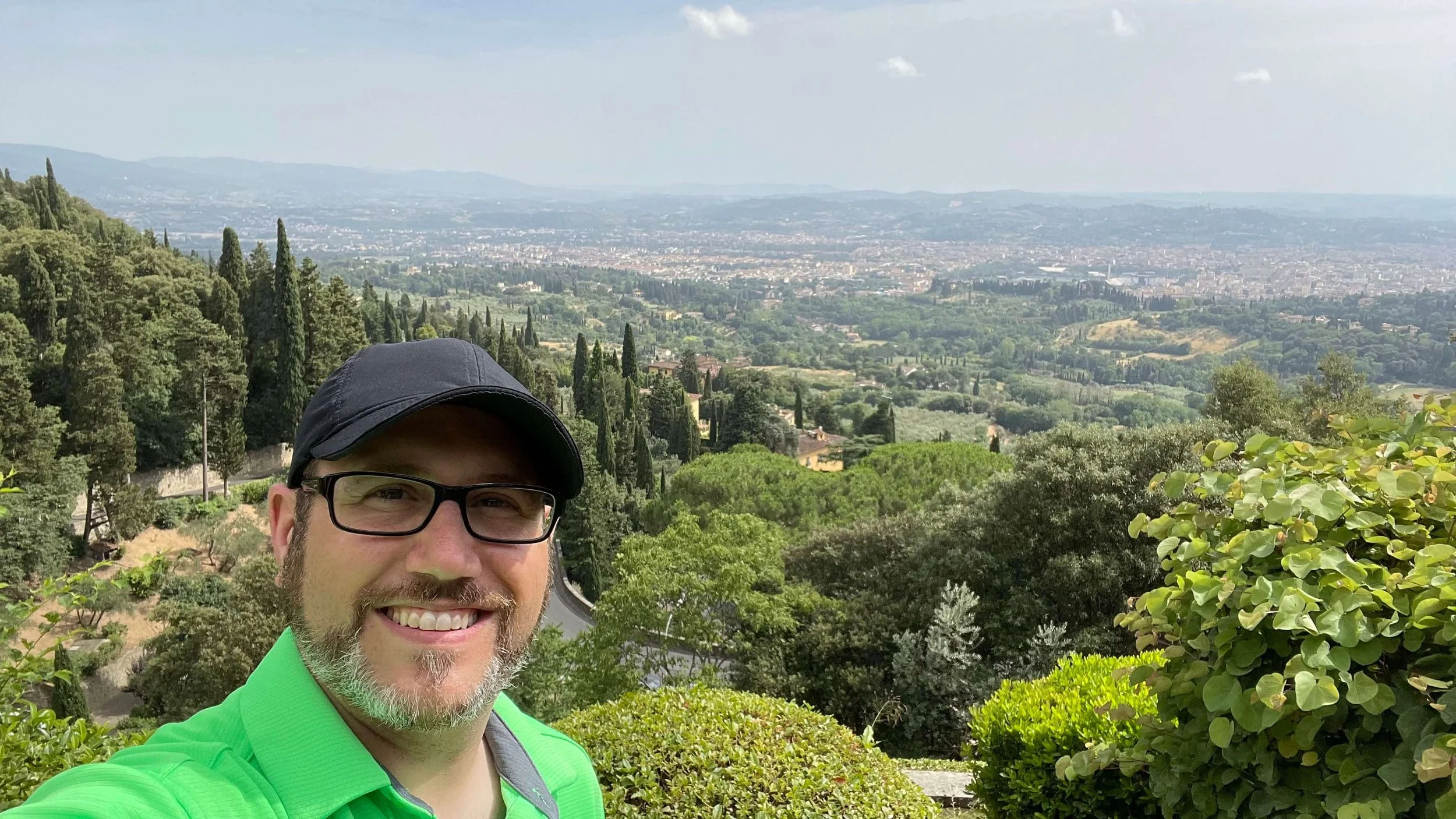
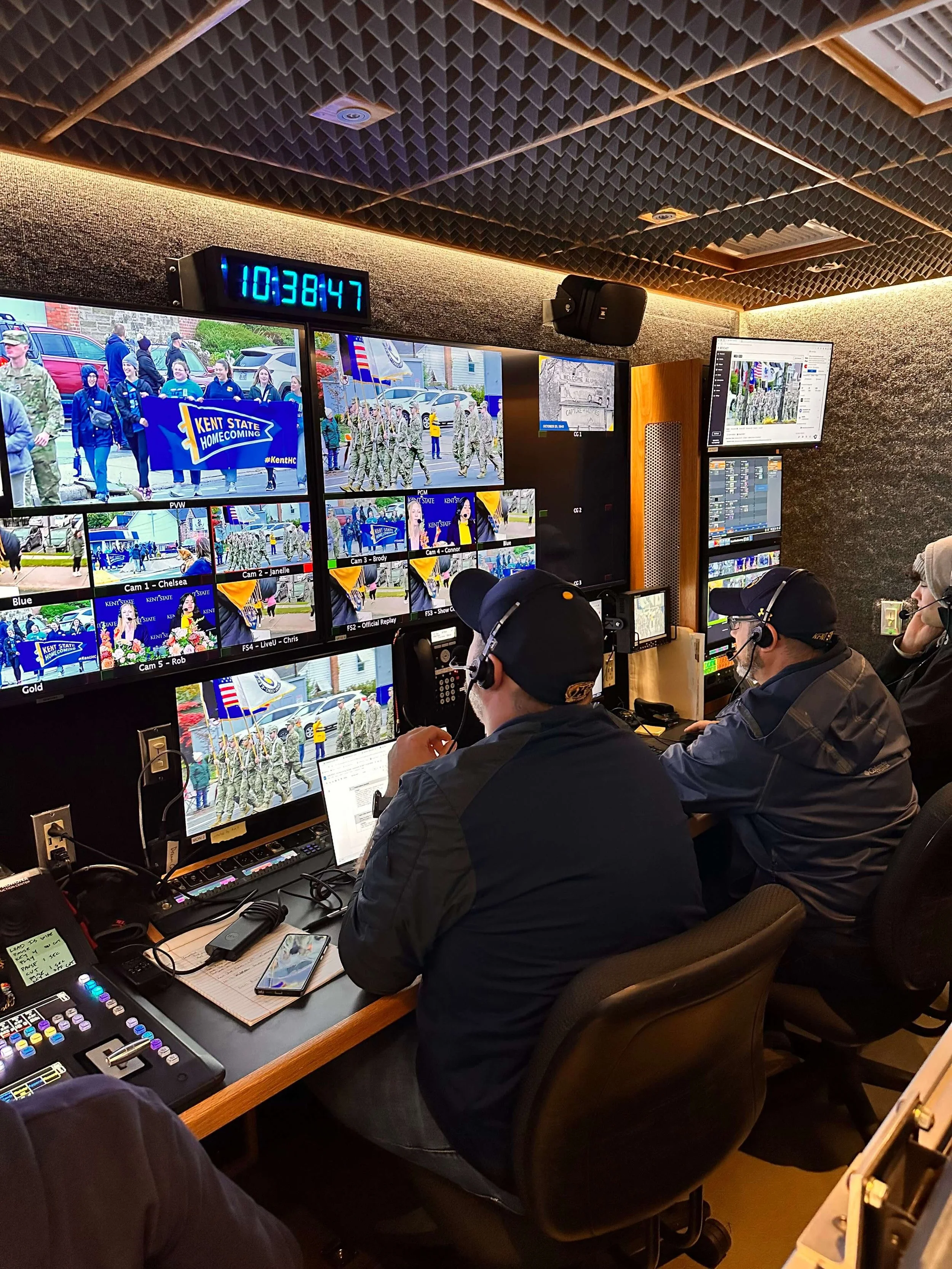
Yeah, so I did first couple of years I had student workers. We would enter, you know, they would apply online. I forget what it was called, handworks maybe. I think that was the program. They’d you know, we’d post the job. It was like an internal thing for all the students. Whoever would apply, I would ask them to supply demo reels, bring them in for interviews. I’d interview them, get to know them a little bit. So I had two student workers in about three years. And then the demand for video was so high that we recently the guy that’s that’s on the team, he had his one-year anniversary on March 6th. So we hired him. I’m hoping that the demand for video continues, it seems like it will, and then there will be an opportunity for other students. But the one cool thing that we do, and this is something that I just wanted to do myself, was to be able to work with students and teleproductions is for the last three years, we’ve streamed our homecoming parade. So I would work with new student media, and they would hire, I was able to hire three students to be talent. So two that would sit at a table and you know be our host and co-host, and then one that would last two years we were able to put one with an RF and they’re this the students riding on a float, like interviewing people. We hired teleproductions, we got to use their truck that you’re familiar with the last two years, and use one of their directors, but then an entirely student-run production from there. So it was myself and a director sitting in the truck. I’d kind of be quasi-EP and I would create tons of content for it, whether it’s pre-made spots or if I know we’re doing something for global education, I would, you know, I’ve been blessed enough to have Kent State send me to Florence, Italy twice to cover some amazing events that happened over there with our donors. And we had a global education focus and you know, created some short videos and then some long-form videos to celebrate our 50 years of studying abroad in Florence. So that was part of that homecoming stream. And I’m proud to say that we won our first award for that stream this past year was an educational advertising award. I know it’s not an Emmy, but still, I mean, to be recognized again in a different capacity, not as a shooter or editor, but as an executive producer. And then I’m most proud of the students just because I mean to be able to do what they do and get that experience, that’s why I want to continue to do it, do this stream for homecoming, is it’s not a typical experience. It’s not a basketball game, it’s not a play for the theater, it’s not a fashion show. It’s literally a live moving train that once the parade starts, it doesn’t end until the last float goes through. So it’s a lot of fun.
TMac 56:46
What is the most rewarding thing? You were hinting, you know, be more specific. What’s what’s the most rewarding thing now after that journey? Now you are still part teacher, still part production pro. What’s what’s the most important or most rewarding thing about your job now at your alma mater? Sure.
Jeff 57:16
The most rewarding thing is being able to meet these students and to tell their stories to help raise more money for scholarships. Because higher education is it’s not cheap. And the more money we can raise to help them get a higher education to be a better part of our society. I mean, it just it changes communities one degree at a time. And I’m I’m heavily focused on higher ed and I love being a part of giving back at Kent State University. And you know, and that could be monetarily with my time, teaching, you know, students that I work with my craft. But yeah, there’s there’s a lot of rewarding things, but being a part of the beautification of campus and helping students achieve their dreams, it’s a great feeling on a daily basis.
TMac 58:17
Yeah, man. All right. Last question. You’re unique as a guest because you have you have interviewed young, aspiring media professionals, production professionals. So I’m gonna ask you the same question that I ask all of my guests, and that is what three things would you tell an aspiring media production pro that they should have before they go in and interview with Mr. Alberini.
Jeff 59:05
I haven’t been called Mr. Alberini since I was a teacher. That’s funny to hear. Top three things. I would say you got to do your research on the position and the organization. And then from that research, you’re gonna build a demo reel that is custom to that job description. Unfortunately, in our industry, you can’t just say you know how to do it, you got to show us you know how to do it. So a demo reel is key. A good demo reel, and I’m still a firm believer in a good cover letter, even though a lot of people don’t believe that you know that weighs as much. But I read every single cover letter. You can tell when they’re cookie cutter, and you can tell when they’ve been customized to the position and if they’ve done some research, and then when you see their work, I’m constantly trying to like look and see how does their work that they’re showing me translate to this position. You know, I think the second thing would be I want to see the passion that you have for this industry based on how you communicate to me in an interview why you want this job and why you want to work in this industry. And then I would say the last thing is knowing that you’re not gonna know everything, and nobody does. I don’t know everything, and I’m 20 plus years into this career. The thing that you have to prove in an interview is that you’re willing to learn and you’re willing to adapt because technology and software will continually change, but if you have a strong foundation through education, you can continue to achieve everything that you want in this production world.
TMac 01:01:11
That’s my brother teacher, man.
Jeff 01:01:14
Yeah, man. I tell you what, what we do, I know I’m not currently a teacher, but what we do, it’s it’s very technical, but at the same time, you’ve got to be able to communicate what you’re doing and when. And I think that’s another part of live production that not a lot of people talk about is listening skills are just as important as being able to speak and write. You know, and I think that’s a key in an interview too. Sometimes it’s okay to take a breath. Sometimes it’s okay to pause before you give an answer because it’s showing me that you’re actually thinking and you care about what you’re about to say, versus I’m just gonna spit out what I rehearsed.
TMac 01:02:03
Fellow Kent State grad Jeff Alberini, I can’t thank you enough for being a part of the project.
Jeff 01:02:11
Thanks, brother. I appreciate you having me on. It was great catching up with you, and I hope that you know, some aspiring filmmakers and video creators see this and for how great it is, and you know, hopefully they can walk away with a couple of nuggets of information that maybe they didn’t know before. Go Kent State, go flashes.
TMac 01:02:43
Thanks again to the multi-talented Jeff Alberini, Senior Associate Director of Video and Digital Outreach at Kent State University. The Zoom with our feet podcast is a production of TV Commando Media. The Zoom Pod theme is by Novembers and their funky groove Cloud 10. Until next time, creators, be ready to accept the challenge.
More From Jeff