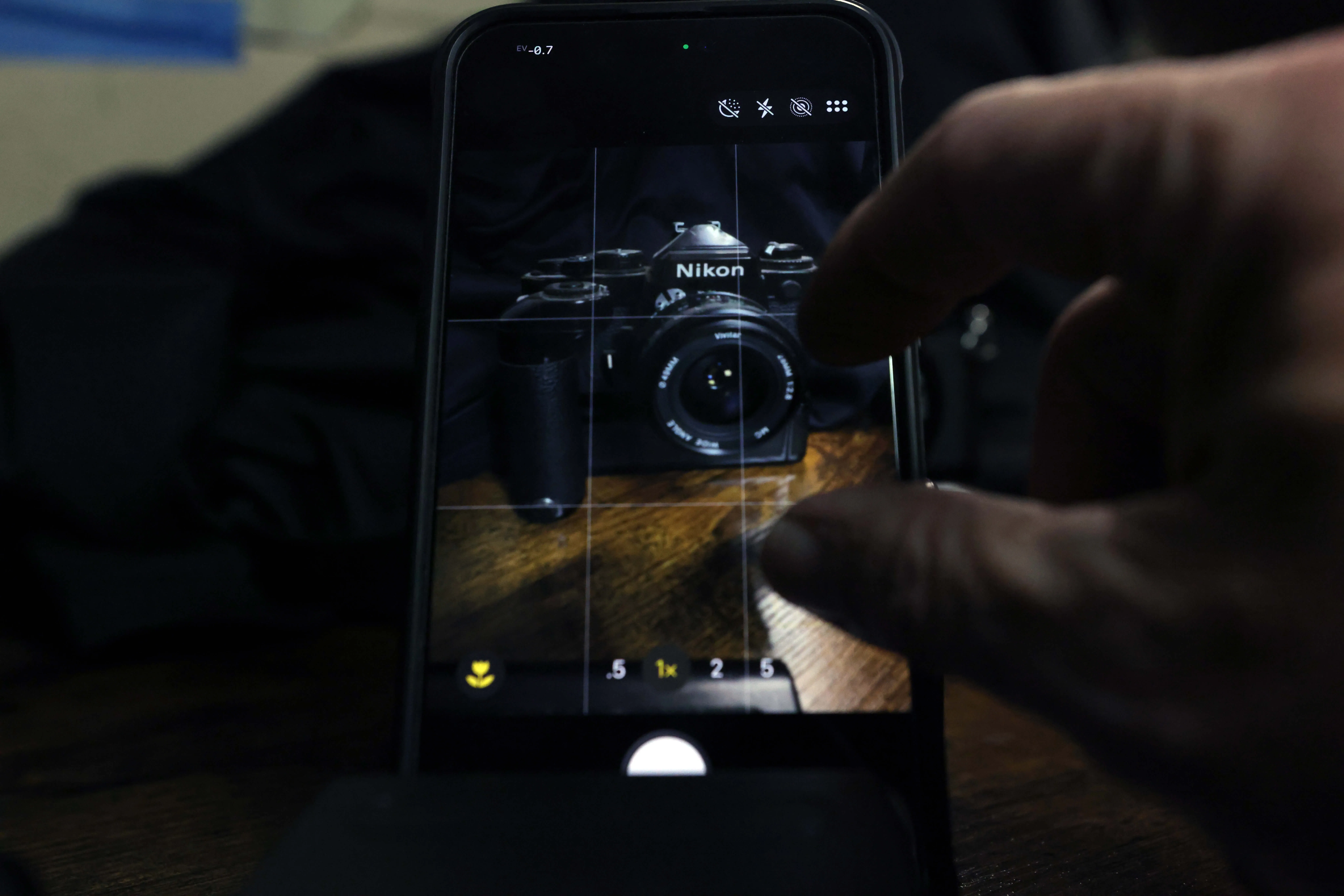
I learned this before I had words for it. Nikon F, nifty fifty, no zoom ring anywhere on the thing. If I wanted to get closer, there was exactly one way to do it.
Close up meant get closer. Get closer meant move your feet. That wasn’t a philosophy yet. It was just the only option I had.
The Miss
Here’s what I didn’t expect. Moving didn’t just solve the distance problem. It solved a problem I didn’t know I had. Every step I took toward a subject changed something else too, the angle I was seeing them from, and the angle the light was hitting them from. A fixed lens didn’t just teach me to get closer. It taught me positioning, subject, me, and the light source, all three, without ever meaning to.
Most beginners think zoom and position do the same job. They don’t. Zoom changes size. Position changes everything.
Moving creates shots. The camera doesn’t.
The Photo Lab
The Lesson + Lab
Twelve years after that Nikon F, I was on a CNN promo shoot. Same instinct, different stakes. I had one lens, still fixed, still no zoom ring, and fifteen rolls of film to work with. I didn’t reach for a zoom that wasn’t there. I moved. Stalked the subject from every angle I could find, because by then that wasn’t a technique I was choosing. It was just how I shot.
Funny thing about the people who love to preach the purity of a prime lens. Fixed focal length, no zoom ring to lean on, they’ll talk your ear off about how that forces real technique. They’re right. It does. It’s the same lesson I learned on a Nikon F in the seventies. What they usually leave out is that the 300 I shoot now has forced me to move plenty of times too, and more often than you’d think, that’s meant moving away from a subject, not toward one. Logistics, safety, the shot itself sometimes needs distance instead of proximity. Movement is the technique. Knowing when and why to move, closer or farther, is the mastery. That’s the part the purists skip past on their way to feeling superior about a beginner’s phone.
One thing worth saying plain. If there’s a fence between you and something with teeth, that fence is doing you a favor, use every bit of zoom you’ve got and be glad you have it. Getting closer is a technique. It’s not a dare.
That’s the part that matters for you. It wasn’t talent. It was a limitation that turned into muscle memory, the same way Lesson 1 of Unit 5 shows a 70-200mm lens answering a question most people would’ve reached for a bigger lens to solve.
Your phone doesn’t have that limitation built in. It’s got a pinch-zoom sitting right there, tempting you to skip the whole lesson. Pinch, and you lose resolution, you lose sharpness, and worse, you lose the angle you never got to discover because you never moved. Every ZWOF lesson in this unit comes back to the same idea, own the camera, own the picture. Zoom is the clearest version of that decision there is. It’s right there in the name.
Try This
Next time you go to pinch-zoom, stop. Take three steps closer instead. Take the photo. Then take a few more steps and shoot again from a slightly different angle. Compare all three. You’ll usually find the best one isn’t the closest one, it’s the one where you found an angle pinching could never have given you.
Reflection + CTA
I’ve shot with a Nikon F that had no zoom, and I shoot now with a phone that’s begging me to use one. Same rule applies to both.
The name of this whole platform isn’t a slogan. It’s the first technique I ever learned, and it still works.
Trust it. Trust yourself.
-TMac #shooton
