
Nick Gambone — Cleveland Guardians, Sports Media Leadership & A Pizza Drive-Thru That Launched a Career
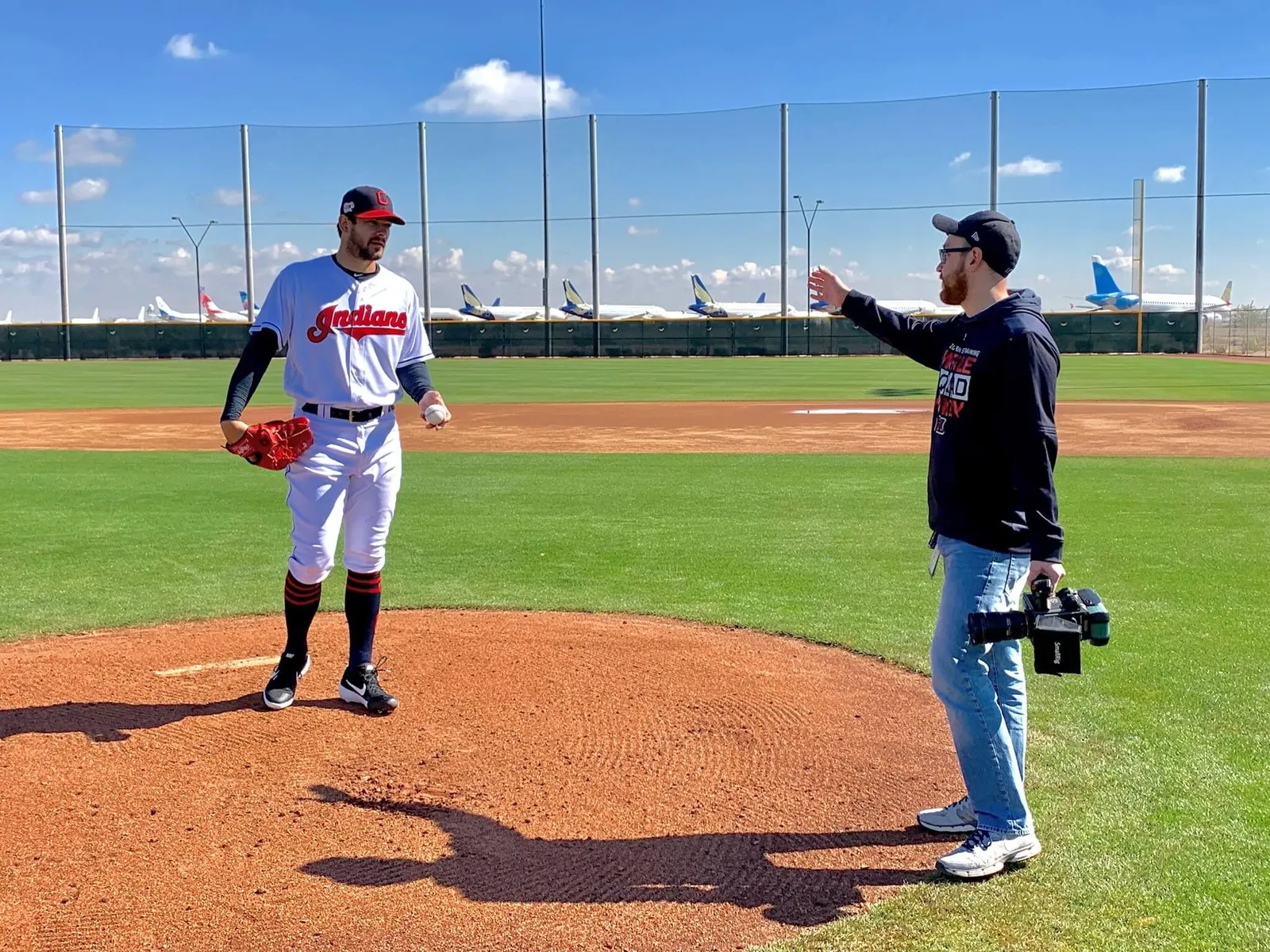
Nick Gambone on the mound at Indians Spring Training. Directing the shot. This is what the pizza drive-thru conversation eventually became. Photo Credit: Nick Gambone. Used with permission.
Nick Gambone sat in a high school video class not knowing it was the first step toward a career in professional sports media. Today he’s the Assistant Director of Creative Production for the Cleveland Guardians.
The path between those two points runs through Kent State’s TV2, unpaid internships, a freelance hustle, and a pizza drive-thru window conversation that nobody planned but nobody forgot. In this episode Nick talks mentorship, initiative, and what it actually takes to grow from a student with potential into the person doing the hiring.
Why It Matters
Creative careers are rarely straight lines. Nick’s story is proof that longevity comes from trust, attitude, and being ready when opportunity appears. Not from titles or tech. For any young person trying to break into sports media, this is the episode that tells you what actually matters.
About This Guest
Nick Gambone is the Assistant Director of Creative Production for the Cleveland Guardians, where he leads in-game experience and digital content production. A former student at Hoover High School and college roommate of Paul Taylor at Kent State, Nick’s path into sports media ran through TV2, freelance work, unpaid internships, and a chance conversation at a pizza drive-thru with Steve Warren that changed the trajectory of his career. He now hires the interns that remind him of himself.
Nick’s Bonafides
“
I don’t hire on perfection. I hire on potential and hustle.
”— NICK GAMBONE, ASSISTANT DIRECTOR OF CREATIVE PRODUCTION, CLEVELAND GUARDIANSHear This Episode
Episode Timestamps
Your ZoomPod — Exit Ticket
After this episode, you'll know:
- Why most career breaks come from relationships, not resumes
- What hiring managers actually watch for before they offer someone a shot
- How team-first behavior signals leadership long before a title does
- Why mentorship outperforms credentials in creative careers every time
Gear & Affiliate Links
Trick out your kit, and your wardrobe. Both Adorama and SmallRig are having sales right now. Or wear your photography mood, grab a ZWOF set-wear tee shirt. If you use a ZWOF link, we may earn a small commission that doesn’t increase the price of your item.
Nick got closer to the work by showing up, saying yes, and being ready when opportunity arrived at a pizza drive-thru window. Same instinct applies every time you raise a camera.
Stop Shooting From the Stands →Nick 00:06
That’s part of the culture that you build is that safe area to talk about these growth opportunities. I have two people that I that I’m thinking of when I’m talking about this. When you see them help others and like not their role, not their job, but they’re they’re there just making sure that the team gets the project done and they’re there for the betterment of that. And they have the team goals in mind instead of their own goals. That’s that’s leadership quality right there.
TMac 00:39
Hello and welcome to another edition of the Zoom with our feet podcast. With me, your host, TMac, professional photographer, videographer, and teacher. So, what makes a teacher proud? To see their fledglings go on to do great
TMac 01:03
Things. I’m very excited to chat with a former student of mine who somehow managed to survive my first year teaching. And not only did he survive, but he became a great husband, father, and integral part of the Cleveland sports media landscape. On this episode of the Zoom Pod, Nick Gambone, Assistant Director of Live Experience for the Cleveland Guardians, talks about his media creators’ journey. It’s hot stove time for baseball, and our guest speaker is in the photo lab. Let’s talk to a pro. Nick Gambone, welcome to the Zoom with our feet podcast. How are you?
Nick 01:53
I’m doing well. Thanks for having me, Tim.
TMac 01:56
Oh, thanks for being here. Former student, full disclosure. I hope things are well.
Nick 02:03
Yeah, I have fond memories of being a student back at Disverton and having you at Tom teach us the ropes.
TMac 02:10
Nick was in my very, very first year of teaching, and clearly he has survived and thrived, and I had nothing to do with it.
Nick 02:22
I don’t know about that.
TMac 02:27
You’ve had an interesting an interesting career, my man. So the first place I always start with everybody. So the reason I started this project is for me, A, keep teaching, b to sort of prove to everyone that everybody’s journey is different, it’s original, but the thing is everybody started somewhere, and you can’t sort of judge us by where we are now. And so what I like to talk about is the journey itself and how you got to your current position with the Cleveland Guardians. So let’s work backwards from that. And what is your origin story in media production?
Nick 03:25
I love this. What’s pretty wild if you think about it too is I’ve been with the Indianslash guardians now for 20 years, which means I started there in 2005, and I graduated high school in 2003. So a lot of my skills that I had going into that job right out of the gate was because of the video production class that you guys taught.
Nick 03:50
And that’s pretty incredible to really think back on. But right outside right out of high school, went down to OU and spent a year there and didn’t get my hands on any equipment. I was not in any video production classes, and I was then driving back to the Kent area to freelance, college football games, and you know, and make you know a hundred bucks a game. And I’m driving a Jeep Wrangler from Kent to Athens, Ohio, so I’m spending all my money on gas to just work those gigs. So I moved you know out of OU after that first year. I will say a little bit of that partying may have also been you know a reason for moving away from Kentucky.
TMac 04:31
Of course.
Nick 04:32
But you know, you move to Kent, it’s not like it’s that much different of a school. It’s just a lot closer, which was great. And it afforded a lot of opportunities for me to get my hands on equipment right away. I did listen to your podcast with Paul Taylor. Shout out to Paul Taylor, who was my roommate at Kent State, actually, and is my best man, was my best man at my wedding. So Paul and I go way back. But he and I started at Kent together because he also was his first year was at a satellite branch of Kent. So we both went to main campus at the same time. We became roommates. There you go, flash it off. We became roommates, but then really we got into the TV2 program and the in the studio there, and we found that if you just wanted to do stuff, you could. And we were like super gum ho. We were ready to get our hands on anything. I had spent a year not touching any equipment essentially. Paul had spent a year at a satellite campus, so he was like eager to get his hands on equipment too. And you know, we jumped in. I was a sports director my first year there at the news station, my first semester. And like that to me is just a testament to what you can do when you find the right school and you find the right people around you to get in and then start having fun and then realize how cool this industry can really be. But man, that first that those first couple years at Kent, they taught me a lot. It
Nick 06:05
Was really like college was a figure it out era for me. You know, it was a lot of learning by doing, shooting, I was editing, I was creating graphics, I was producing shows, I was doing all these different things that I had never done before. And I think you know, one of the things that I did when I was young was I said yes to a lot of things before I was ready. And I was confident in my abilities, and again, I had a lot I’ve had a lot of hands-on under my belt as I started saying these things, and it was just like you just keep, all right, I’ve never done that, but yeah, I can do it. And it eventually turned into you know a career, which is kind of insane to think, but I wouldn’t you know, like you said, everybody’s journey is unique in their own right. And I thought at least a dozen times in those first couple of years that this is not the industry for me, this is not a career worth pursuing. My father was like, you need to like get out of this and get a real job, find something else to do. And I just kept saying, no, this is fine. I’ll do this for a little while, and then if I can’t figure it out, I’ll get a real job. 20 years later, I’m still doing it.
TMac 07:24
Well, I also think it is a testament to career tech education. Shout out to career tech education. I am a huge proponent of what you just said, which is do it hands-on, experience all learning. And I think that for some Hoover students, I’m looking at you, that was a hard transition to then go to higher education and almost an a different learning model where they set you aside, you have to take the classes first before you even, as you said, get access to the equipment, get access to right, because it’s run by the student media, it’s run by the folks that put all that time in. Well that was a that was always a hard transition for students coming
TMac 08:25
Out of a pretty sophisticated video production program like Hoover High School. So I you’re not the only one that had that issue in that transition, but I appreciate you saying that you found it based on what they let you do and also what you could talk yourself into. And that’s obviously why you stayed. When did you graduate?
Nick 09:01
2000. So long career in maybe we can shorten this later, but went from OU to Kent to Akron to Cleveland State, more as a way to kind of get myself up to Cleveland. In I was already I was working by 2005. So really, you know, as a sophomore junior in college, I was trying to balance a lot and it and it was tough. So it was you know, I wouldn’t I hope my children don’t hear this. I have two kids now. But you know, college isn’t always the path that you need to take. And it’s not always one college either. And I think, you know, when you start to form a career, you have to make decisions informed on where your life is at that moment. And that’s looking back on it, that’s easy to say. In the in, you know, at the moment in the time when we were going through it, and you know, I was saying, all right, I’m gonna transfer to another school. Though those were tough conversations to have, and you have to be confident in yourself. But you also have to surround yourself with the people that are gonna support you in whatever decisions and career path you want to take. And that’s a big part of also you know why I’m here, is also really having a really good support system this whole time.
TMac 10:19
How do you think your Hoover experience informed your college experience?
Nick 10:26
So my Hoover experience was one of one of my one of the best memories I have in high school was being in that class. And it allowed me to work on programs like Abbott. And it’s crazy the like final time Abbott. I think we were using Premier actually, even that first year that I was there. And those are softwares, again, that you don’t get your hands on, especially MAPI when you get into college. And so the things that I knew how to do coming out of high school were beyond what I found at OEU, even at Tech State, Akron, Cleveland State. Nobody had the software or the small class size that Ruber had. Where you’re basically turning up one other person or doing projects yourself, and then there was almost a one-to-one computer ratio for kids at our high school, which is insane. We’re talking 20 years ago. We’re talking about 20,000 editing machines. One to one. That’s that’s that’s that’s wild. And so you know, once you start to realize that, it did a lot of reflection as I got out of a couple of those colleges and then I was moving around and it was like, hey, you know, you know, you know how to use this software, you know how to shoot and edit and produce. Go look for that job. Go try to find that and then that’ll get you your hands on experience where you’re trying to do your book, you know, all the other classes that you need to get in college and balance that. And that’s where I was trying to get my fulfillment when I when I wasn’t able to get my hands-on equipment right away. I was getting through those freelance gigs. And all the time. Ultimately, those
Nick 12:10
Freelance gigs led me to Cleveland, which led me to you know the Indians, but that’s that’s what it was. It was it was it was just following that path. It was saying, hey, you know, I know this person you work in the cast. Like when do they hire it? What like when can I get into? I was I was a camera everywhere I went to start. You know, it means you start at the bottom of the ladder and you work your way up. But when you’re when you’re freelancing, when you’re 18, 19 years old and you’ve got no other skill set really. You’ve got a new attitude, you can pretty much make it anyway.
TMac 12:50
I’m stealing that. There is also some lore, Mr. Gambone, and I have it on very good authority because he was also on the podcast. There is a legendary story about you working the drive-thru at a pizza place and encountering someone from the media. Shout out to Steve Warren. So I’d like to hear, I have heard his side of the story. I would like to hear the other side of the drive-thru pizza story. Not just for just
TMac 13:31
Thinking of it, but seizing this is a seize the moment lesson for anybody that wants to be in media and a you know, you could do all the normal stuff, typical stuff, and shake hands and meet people, or you could do what Nick did. Carry on.
Nick 13:58
I didn’t listen to Steve’s podcast. Exactly 20 years ago.
TMac 14:06
Love it.
Nick 14:07
But I’m only worked in a pizza place, so let me wait, let me can you just give you a reading.
TMac 14:14
There was a there was a brief discussion with him. You recognized him. This is this is from Mr. Warren, that you recognized him and said, you know, are you hiring?
Unknown 14:33
-.
TMac 14:34
Words to that effect, and that you were a student in Hoover Video Productions, which for Steve is like the ultimate, because he likes to call himself patient zero in the way back in the 70s when the first camera arrived at Hoover High School. They handed it to Steve. But his story was you he arrived to pick up a pizza and met a young Nick Gambone who recognized him, asked him, how are you doing? I’m I’m Nick Gambone, I’m video production student. And in so many words, are you hiring?
Nick 15:18
So I think I’m gonna be able to do it. True or not, sir. I do remember the story now. Just hearing a couple of words. I was working at the pizza place. And I was really the pizza maker, not necessarily the window operation type, if you will. So it was really lucky that I walked over to the window to you know give this man his pizza, and I look up and I see Steve Warren. And you know, if anybody knows Steve O, he’s recognizable, and he’s got this, always got this smile on his face and is approachable. And as you know, you know, as I’m in him as pizza, I just felt like there was an opportunity to talk to him. I knew what he did, we were communications, and I said, Hey, I know you’re from North Kingdom, you’ve come and talked to our class before. I know that you work in Indians, and I would love to get a job there. Are you hiring? What you didn’t know was that I was moving back from OU, I was free because I didn’t know what I was gonna do. It was really one of those like just meant to be the moments, I think, because that was the start of a really awesome relationship between Steve and I. And I still see Steve around from time to time at the ballpark. And I’ve told him that’s one of the things that always is in my head within him is that someone’s he hired me as an intern in 2005 and he left the following year to go work for sports time. I’m still kind of processing what that means. I’m not sure he would like to try and burn bridges on his way in and like let’s get in here, but it’s definitely not a joke, a joke. He was he was he was just an incredible person. Obviously ran a really great department that I came into and got to jump in and have fun every way. And then
Nick 17:20
He was still around, so I got to talk to him pretty regularly those first few years when he was with STL. I don’t see him as much anymore, but I definitely see him two or three times a year, and we’ve always got that wave or handshake whenever we get up to him. Steve always a unique person, and I truly wouldn’t be here like to today where I’m at if it wasn’t for him.
TMac 17:44
Full disclosure. His side of the story, because he is a master storyteller, includes the following that there was a resume taped to the top of the pizza when it passed through the window.
Nick 18:03
But a good version details. I don’t know if I have those readily available with me at the pizza shop, but that does sound like a C H little acknowledgement. But you know, there’s a good chance I sharpened my phone number on that pizza box.
TMac 18:20
I think what is impressive to me is the Hutzpa to do it, to understand and take advantage of that serendipity. I mean, and most people would just like, oh, that’s right, but to step out of yourself and whatever you may have thought of the situation, you acted, and that says a lot about probably how you’ve conducted yourself, and there’s a fearlessness about how you attack work. So yes, it may seem a little embarrassing now, but I’m sure at the time it was I should I should grasp this opportunity. I know that he appreciated it just for its originality and just the knowledge that you he thought, you know, this is off camera, sir, that he you know he appreciated you stepping out in doing that. I think the lesson I want to impart on people, and I think you’ll agree that are that are you know want to work in media production is sometimes you have to take a chance. It’s it’s you mentioned it before, everybody’s everybody’s journey is different. Mine is completely different than everybody else’s. However, some of the consistencies. Are stepping out of your comfort zone to introduce yourself to somebody, having mentors, because after that I’m sure he became a mentor. And even though he wasn’t directly working with you anymore, he was checking up on you. I know he was, because I’ve done it with former students, so there’s a kinship, I think, in the industry. But I just love that story, and I wanted to try to embarrass the crap out of you by making sure that you knew he told that story to me in his interview because we were talking about former students, and he said, Yeah, I embellished it. What
TMac 20:50
I tell people, I yeah, he stuck a resume on the pizza. So that’s a pretty famous pizza, is basically what I’m saying.
Nick 20:58
I love it. I think it is a good story too. And to your point, like if you don’t put yourself out there, it’s gonna be tough to really try to make some of those moves that you want to make. And you gotta not be worried about failing or embarrassing yourself because what’s the worst that’s gonna happen? Like they say no, right? What’s the best that can happen is 20 years later. So we’re working.
TMac 21:24
Well, speaking of that, that’s a good segue. So let’s talk about so a couple of journeys. So journey from Hoover to a professional break. Now you manage to you know, the pizza guy hired you. The pizza guy got hired. So now you were hired as what internal.
Nick 21:50
So I was I was a seasonal intern, which meant you know you know April to and end of September.
TMac 21:58
Okay. What did pay?
Nick 22:01
This is amazing. Zero dollars perfectly. This was this was before laws like three or four years later, laws came through that said you can’t have unpaid interns. My full internship year. No, no, I did pick up a couple of pay throughout that summer, but I think I made $2,000 the entire summer. And that was that was essentially my gas call driving from Texas to Label.
TMac 22:28
Right. And inter job descriptions can be pretty wide. How was how was this one?
Nick 22:40
I you know what’s crazy is this job description was pretty I don’t I don’t even know if I can tell you what it was specifically, but it allowed me to it allowed me to edit videos, it allowed me to shoot, it allowed me to work on a game day and work positions like main scoreboard. That’s not even a position you would even have on a regular podcast, right? Scoreboard operators that’s that’s kind of different. This was a year after the brand new 2004 scoreboard was built. So it was a it was a new toy for them that I got to just basically he sat me down and said push buttons until you think you’re broken. A 19-year-old kid who doesn’t know what they’re doing, but that wants to learn. And so obviously I pushed every single button I could to figure out what things did. That first year taught me a lot. It taught me that I can work a job that I love, making no money, and I’m perfectly happy, which really informed me for a lot of the rest of my career that you know, do I want to chase money or do I want to chase the feeling? And I you know that feeling that feeling goes like this. Every job that you have, you love it, and then there are times you hate it. But I think more often than not, I still love this job, and it started with that first year knowing that I can do it for free, honestly. And that was a big thing.
TMac 24:14
And I think Steve also
TMac 24:16
Probably that first year told you about professionalism and showing up, keeping up, and understanding it’s a lot more corporate than people think, and that you know there’s a lot to learn beyond pushing buttons. Tell me about that transformation as well.
Nick 24:45
Yeah, yeah, those early years were pretty awesome. There was just a really good group of people that were there that were really they cared about the people around them. And I think you know a lot of that came from Steve’s culture and his ability to impart just a great working environment around him. But I don’t I think it’s pretty rare for people to teach you how to do a job really well, especially on the broadcast side. The broadcast side is different than maybe an in-house gig. It’s it’s a lot of people think that in-house is really a step, they just don’t get to broadcast, and a lot of times it can be. People don’t like to teach you things, or at least they didn’TMac then because they were worried you’re a young kid, you’re gonna take my job. Like there’s only so many years I got left with this camera on my shoulder. I’m gonna try to do that, and I’m not gonna tell you how to do it. You take that to the Indians at that time, and it wasn’t that. It was hey, hey, here’s how this works, here’s how that works, here’s why we do this. And the why became the most important part because that’s how you learn not to just push this button, but why you push this button. And those are some of the things that just Steve O, but again, the crew that he had there informed me how to how to be that kind of person. When it comes to professionalism, I will say like that is something that I feel like being an Eagle Scout and I and I worked with you on gigs, and I’ve worked with Tim or Tom on Gigs. You guys are professional. And as much fun as we have behind the scenes and doing different things and communicating, just talking and joking around. When it comes time to do that job, I saw you and Ms. Wilson snap into those, and I’ve seen those people that can take it from the joke and then oh, it’s my job now. And they’re serious and they’re focused. No, they’re not tight, they’re still loose, they’re having fun with it, but it is a shift to oh, that’s what a professional looks like. And you start like if you’re paying attention, you start to really see that right away. And I was able to see, okay, okay, here’s what professionals look like. And I mean I was still in college, but here’s what college kids look like. And I’m and I’m like, wow, those guys are a good job. I know that. So I’m gonna act like a professional a little bit.
Nick 27:12
And you know, you know, by professional in the video production world, you know, standards are still pretty low. So you know, it was a pretty easy bargain for me to move into only being two years removed from our high school video production class. And then I’ll also have free like a bunch of gigs. You know, you know, it was easy to almost rise to the top in that group, even, which I was able to do, but rise to the top in that group because I had a wide skill set. I could talk to people. And I’m not sure. And I was a young kid who kind of fearless. Maybe it was my own ignorance, but I was kind of fearless going into every kind of endeavor that I tried to do.
TMac 27:48
So what’s next then? So intern, what do they offer?
Nick 27:53
So that was 2005. In 2006, they offered me a part-time year-round job, which I thought, yeah, absolutely. You know, you know, still in school, but I will take a you know, I’ll take a year-round job right now. And you know, it’s a terminology, it’s basically a full-time job, but just hourly, right? Gig. At that point I had gotten to know a lot of people on our crew. That same year I also started working for Cast as a freelancer. And I was running under the hoop for a little while. And then there was a game, I’ll never forget there was a game LeBron’s like the first couple of years, too. By the way, right under the hoop in those first few LeBron years. Incredible. Yeah, absolutely incredible.
TMac 28:41
So wait, sad story. Wait, this is how this is how old I am. I can remember during my heavy calf years, they St. V used to play in the afternoon at the arena, the gunned. That’s how far back I go. And so we’d be setting up for the Cavs game, and it was funny to be able to like look out on the court and go, who’s that adult out there playing with the with those kids? Like you would stop and you’d go, Who is that? And I have very distinct memories of doing that, of being on the court, of setting up for the pro game that was that night. Saint Phoebe was beating the tar out of somebody, and you just looked at this kid and you went, he’s not what he’s gonna play. He’s a high school player. Sorry, continue. LeBron is a good example of being able to experience that you were paying attention, is what I’m trying to say.
Nick 29:49
Absolutely. And so the in 2007, when I started 2006 season, I think that’s what it was. When I started working for the Cavs, I was grip, and I’ll never forget there was a game I couldn’t tell you when, but like halfway through that season, probably in December-ish, the other. Under the camera operator, under the camera operator clicked. When they made it in, and they were looking for anybody with camera experience, and I was like, I’ve not done that. And I was on to grip that game anyway, under that same hoop. And I sat in that chair, and I cannot, I’m not I may have not I may have only missed two more games the rest of that season. They loved what I did. And that was when I knew that was when I knew I could be a real camera operator. That was when I knew this was my calling, this is what I could do. They put me under the half side hoop as a first-year employee halfway through the season. That’s crazy. And I’ll tell you what, I wouldn’t have those camera skills if it wasn’t for you. So I like thank you. And I’ll never forget this may be a segue back even a little bit further, but one of one of the first camera moves you top, you know, I produced our football video right now.
TMac 31:08
Your past coming back to haunt me.
Nick 31:10
No, no, this is this is this is a good story for you too. Don’t worry, I got some other ones I’ll tell later.
TMac 31:18
Yeah, I know where the stop button is, pal. Go ahead.
Nick 31:23
So we were at that first football game, and you were in charge of teaching me the roads, like what to do. I had a camera. I was always like, where do I stay? What
Nick 31:35
Do I want to do? And you’re like, yeah, yeah, we were so great. I don’t even know if you remember this, but you’re like, all right, so we want to try to stay about 20 yards ahead of the play. And we you know, when you get into that missile zone, you’ve got to make that decision whether or not you’ve got to get to the other side of the team or you want to stay on this side behind the wall.
TMac 31:51
Right, right, right. Covering football.
Nick 31:53
You did the first video that’s yeah, yeah. So we’re standing on the field, and you’re telling me again, it’s it’s the why. It’s it’s not just staying here, it’s not just point at zoom in, zoom out. It’s here’s here’s how you try to capture that. And this goes beyond photo. I know you mentioned like you were teaching us photo techniques, but I’ll never forget this one. So our team is maybe at the 20-yard line, they’re in the red zone. You’re like, hey, you’ve got to go right to the back tile on the corner. And I want you to start on the goalpost, and I just want you to give you a slow hand down to the to the team as they hype the ball. And I’ll never forget the first time I did that, hand down, just as the team is breaking and the guy runs in and scores a touchdown. Right? Right? And then that’s the storytelling. And you were so proud of that’s it. That’s the storytelling we’re talking about with the camera. And then I was like, there’s storytelling you can do with the camera, like it still didn’t dawn on me until you know years later. And obviously, I was like editing that video, even I’m like, oh, that’s a really good camera. Like, but that why you do these things, why you try to capture things in different ways was what resonated with me. And so I took that into this cav’s job. And I was like, well, I’m gonna focus and I’m gonna give them this, and then I’m gonna pull out this, or I’m gonna focus from here to there, and I’m gonna tell the story from under the hoop right on that calves sideline. And that’s why they loved it. And again, that would not have done that had I not learned that from you. So thank you. Because that gave me like a tenure career with the calves running camera under the hoop, which was so much fun.
TMac 33:38
Well, it’s I appreciate it. I can remember that was at the time that football video was real work. It was minimum nine games plus some playoffs, and you were a single camera your way through it, finishing with essentially a documentary on the season. You had to interview seniors, you had to cover every game. And I can remember when Tom and I talked about it, I was really excited because I thought this is real-world experience. Someone is gonna walk away from this experience with what you just said. They may it may not click right away, but it’s going to help them along the way. And I can remember all the different students that did that job, almost all of them are working in the in the industry because I think that type of work early sets the hook. Number one, clearly you mentioned that, but number two, the
TMac 35:00
Skills and using the camera as a tool. I can remember stressing positioning. You don’t want, you know, I do remember saying to all the football folks, are you paying attention when the coin toss when there’s a coin toss at the beginning of the game? And I remember all of y’all looking at me like, what? Coin toss. And I’m like, Yeah, coin toss, because now you know who’s receiving, who’s kicking, and which directions the team are going. And then you all would go, oh, and I would say, Don’t stand at the 50-yard line. If you know that Hoover’s kicking or receiving, you position yourself accordingly. And true story, it wasn’t you, it was somebody else. But I gave him that speech, and he was, you know, a non-believer. And I said, We’re walking ourselves down to the you know 10-yard line, and I said, Here’s what’s gonna happen. They’re gonna kick that ball, he’s gonna run up the middle, he’s gonna bounce around the side, and he’s gonna run right down the sideline. Now, I honestly, I was describing a situation. It happened, and he had it the whole way. All of the whole thing he looked at me and I said, that’ll be $45 advice fee.
Nick 36:25
I love it. And that’s you know, you know, to be a good thing.
Nick 36:27
That’s kind of stuff that like you said, like that’s a project. There’s there’s there’s there’s you’re you’re you get paid for it, there’s so there’s pressure on getting it right. And it was literally my first pay gig and gave me so much confidence in it. It was good confidence or blind confidence. I went out and used that parlay to anything that I could because it was it was it was such like just valuable again. Like I wasn’t doing any of that kind of stuff until years after high school, which was really incredible, I think.
TMac 37:01
I think that what you learn from those experiences you carry forward, you bank it, like you said, but when they when they put that camera in your hand for whatever reason, right? And there’s a lot of people who got jobs because somebody got hurt, somebody got sick, somebody wanted something a different type of job kind of thing. That’s that’s a that’s a pretty standard, but you being able to bank that experience, and even though it didn’t apply directly to football, it applied to camera work. And that’s what you know that’s that’s the universal thing. Okay, so now you’re part-time. When did a full-time your on the team happen?
Nick 38:00
So we it was pretty fast for us in our department. I’m gonna give a quick synopsis of just the guardians here. So 2005 I was an intern. 2006 I became a part-time year-ound employee. And we were going through a department transformation
Nick 38:17
In 2007 where we essentially let any part-time year-round person go with the intention of hiring back a full-time salary employee. It was kind of a way I think for us for us to you know weed out a little bit of the older group. But so 2006 intern. I’m sorry, 2005 intern, 2006 part-time year-round, 2007 full-time long full-time I was a producer of Indian game entertainment. And then we had another full-time producer for like commercials and another full-time producer for like long form documentary style things. But my focus was specifically on Indian game entertainment, and so I created a lot of the scoreboard featurettes that you see that went on the scoreboard, we would play, and then a lot of the animations like charge and mix noise. Those are all from my you know, you know, from my role. Then from 2007, so that was 2007 to 2012. In 2012 I became the manager of video production for the Cleveland Indians, and that’s when I took over the department that created what I was telling about all those producers, so I took over that department and managed those other producers as well as the seasonal staff that works game days. So now the scoreboard staff reports something as well. And then I was also directing then the majority of the scoreboard show games into 2012. So that promotion was a really big one where again I’m managing the department of Create content creators managing the pool of seasonal employees that come and work the games and then also directing 90% of the games. So that was a really big job. That was the first real big step for me. And then from there, it was another, I think it was 2016-ish, when I became the assistant director of live experience, and really the creative director for our organization. And all that really meant was now I also had to, I was also responsible for commercial campaigns, advertising, and everything we went into that. Now I actually don’t have to deal with advertising and brand commercials and all that kind of stuff anymore. And then they didn’t differ for a little while. Now we have our marketing department again, and that’s who’s responsible for all of those commercial campaigns, which honestly was a really blessing because commercial campaigns and those things are those 15-second snippets now you see at the beginning of YouTube videos or whatever, right? So it’s not that storytelling that it used to be. And really, they said, We want you to take your focus back to the in-game entertainment to try to make that the
Nick 41:20
Best it can be.
TMac 41:53
And now you got the opportunity to sort of take on that role officially. So I have been there several times and can say and have been to a lot of parks, and I think it balances the right level of information, and there’s a there’s a balance that you have to try to strike. And I think that you guys you guys do it well for the size of your shop. You’re still accounted, you having to account for the same number of games that the New York Mets are producing, or the LA Dodgers, or you know where I’m going with this. So I think that you’re in the right spot, my man. I’m I’m really proud of you and how you built a career the right way. And I bet in this new role managing creatives, you’re meeting some young Nick Gambones, are you?
Nick 43:09
And what’s funny is I’ve got a video production kid that I hired as an intern, and now he’s been with us for almost 13 years.
TMac 43:17
Wait a minute, who?
Nick 43:18
Mike Donovan.
TMac 43:20
Do you know Mike Donovan? Yeah. Yeah. Good for you. Good for him.
Nick 43:26
Yeah.
TMac 43:28
All right. So here are the pay it forwards questions. This is how we’ll this is how we’ll we’ll end. You know, I didn’t I’d lose my ex-career education teaching card if I didn’t ask you, you know, what’s the next step? You know, what more do you want to do? And I know you well enough to know that you’re open for things, but you know, everybody’s
TMac 44:01
Got I like to say two-year, five-year, ten-year goals. What would you like the next step to be?
Nick 44:11
Yeah, that’s that’s a great question. It’s it’s tough when you’ve been interested in the same place for 20 years. And you know, there’s there’s sometimes aren’t the same spots for advancement as if we were to leave and come back and say, you know what I mean? There’s there’s just opportunities with new newness. And so when you’ve been around for a while, you kind of have to set your expectations appropriately about what those next steps can be. You want to stay where you’re at, essentially. So you know, I can go and be a vice president and entertainment somewhere, easily. Like what I have under my belt and the things that I’ve managed. I can be at that level. But I really like the team. So my next steps specifically are just to continue to build my creative leadership skill set and just see where that takes me. I don’t have a title or a goal or a place in mind, but I want to keep working with people that care about the work they’re doing and care about the people around them. It’s not about for me, again, and I think this is the insight that I get with 20 years in the same spot is that the people come and go, but like the people around you matter. And if you can’t work with the people around you or you don’t want to because they’re not good people, that changes the environment where you’re at. And I’m so lucky to have worked for 20 years with people who I love and I call friends. And that’s that’s why I’m still there. So really my next step is just to continue to grow my crazy thought power and how to help people develop their own thought power.
TMac 45:59
Well said. Okay. So kind of the point of the project are the last couple of questions. So you are now in the position of, or correct me if I’m wrong, are you in the position of hiring interns?
Nick 46:17
So great question. I wish we still had an internship role. We haven’t had an video production intern in a while. We’re not necessarily hiring in that intern role, but we do hire every year seasonal staff to work the scoreboard show. And that is one of the best things that any young kid can get on. Any kind of in-house show.
TMac 46:42
Good answer. So part two, two question, two-part question. Okay. First part is what do you look for in a potential hire? Include hard skills, soft skills. Go.
Nick 47:02
So I always tell people I don’t hire on perfection, I hire on potential hustle. And that to me is why we’ve been successful. That’s why we’ve been successful with the people around us. You know, you know, it’s I can teach you where to point that camera or which button to hit at the right time, but I can’t. But I can’t teach you a go-getter attitude or a self-starter mentality. That’s something that you have to bring to the table. So I always tell people when you go into an interview, be confident, know what you’re talking about. You don’t have to be overly confident, but you have to have a passion for what you’re talking about. And then that passion will come through a conversation. And that’s what I’m looking for. I’m just looking to know that you care about being in the room and talking about this stuff. I want to know that you care about what you’re gonna come do for us. And if you’re sitting there like a bump on a log, that makes it that makes more work for me to pull out what you actually bring to the table. And so if you can bring to the table that skill set, you know, you know, and make it visible and make it known, and you know, you don’t have to be this crazy person in an interview, but you just have to connect with the person that you’re talking to and make sure that they understand you really do have a passion for what you’re what you’re going for. And that’s that’s what I look for most. You know, obviously resumes come through and some skills are better than others. And you know, those hard skills when we’re hiring for a technical director, let’s say those are important. Like those are that you’ve got to know how to use a switcher if you’re gonna come in and be a technical director. So those mixed, you know, so you’ll get that and you’ll see like, all right, this guy you know maybe has a little more skill than this guy, but gosh, if that guy that second guy didn’t give the best interview we’ve had out of the 50 candidates. You know, I’m I’m gonna go with that guy because I want to work with that person, you know, you know, and then that’s that’s kind of the difference. Obviously, we honestly we probably hire both of them and good candidates. But it’s you know, you know, you gotta have the hard skills if you want those above-the-line jobs, and you gotta have the personal skills in any role that you’re gonna be.
TMac 49:15
Good answer. But somewhere along the way, you will have a candidate, I don’t know, a young Gambone, for instance, that has management potential. And do you is in your mind, do you have somebody in mind that I’m asking this question about where and at what point do you start saying to that person, you clearly can do this. You start where I started, which is what do you want to do in two years? What do you want to do in five years? That kind of thing. So, specifically for somebody who loves the work but may want to manage down the road, what do you tell those folks?
Nick 50:17
This is a great conversation to have with your employees. I recommend anybody listening to this who is a manager have this kind of conversation with their employees because that’s hard to do. Part of the culture that you built is that safe area to talk about these growth opportunities. And if you are able to then have these conversations with your people, and I do this regularly. I wasn’t sure you know, you know, as an intern, you know, moving up like when he’d be ready to start managing people. But when you see people that I that I’m thinking of when I’m talking about this, when you see them help others and like not their role, not their job, but that they’re they’re there just making sure that the team gets the project done and they’re there for the benefit of that. They have the team goals in mind instead of their own goals, that’s that’s leadership quality right there. And that’s that’s the kind of stuff that you can identify and that you can you know you know you give that positive reinforcement to. And then you can start to have these conversations of like, okay, well, what does management look like for you? What is creative leadership look like for you? You can you can take those examples that you’ve seen and just kind of give that back to them. Tell them like, hey, I think you’re ready because of X, Y, and Z. And if you know, if again if you have that safe space where you go back and forth, you can also say things like, Well, here’s here’s the couple things I think we would need to do if we want to take that next step. And so through that back and forth conversation, and again, like this is a safe space. Like the goal is to get that person’s mindset in a place of like, all right, I have these things checked off. I’m gonna continue to do those well. And then maybe time email response is a very specific thing I can work on. You know, you know, something like that. And then again, if it’s if it’s a safe space to have that conversation with your employees, then it’s a much easier way to then you know, you know, make an opportunity area a strength. And I think that’s all that’s that’s what it is. So like you see the leadership qualities and you just do it before they’re ready. I mean I mean honestly, like that’s that’s what that’s how they’re gonna learn. And like the good news is like you’re there to help them. So if they have questions on how to manage a certain situation or certain things that pop up or personnel issues, like at this point, I’ve been through a lot of it, so I’m able to help them kind of say, Well, here’s how I went through it last time, or here’s what I did with this person. And they trust me, like once you have those conversations, they really find that valuable. And that’s how I’ve been able to help build that leadership qualities. I’m only I say build, like I’m just playing off of what they’re already good at.
TMac 53:05
Again, very well said, spoken like a manager. I think the you know, in my in my case, I was teaching even when I was a professional traveling camera operator. You are absolutely correct. There are a lot of guys that wouldn’t reach out to the to the grips and to the utilities, and I was like, that’s not sustaining the industry. You know, I was thinking bigger, and I had an experience at Firestone where I went up to see some of the boys that are still doing golf because I, you know, at the height was a golf guy and got to see some old friends and whatever, and noticed a lot of new faces up on the camera towers. And in the TV compound, somebody came up and shook my hand and said, Do you remember me? And I was like, Oh, this is putting me on the spot. And he let me off the hook easy. He said, You when I was a utility, you would let me go up on your camera tower at lunch and shag golf balls. And I said, Really? And he said, Yeah, and that practice made it so when I was ready and got asked, I was I was ready. And it was like, you know, what you are saying for me is you have to be willing to pass on what you know. That’s that’s kind of the whole reason for this project is to just keep teaching, but it was a great experience for me to have someone say, you did that for me. And I’m like, Are you gonna and my parting shot was are you gonna do it to one of the utilities? And he said, Yeah, yeah, I am. And I’m like, Okay.
Nick 55:19
I mean, that’s that’s just it. Like the industry you were a diamond in the rough, like back then. Like there were not a lot of people that I’ve been called.
TMac 55:29
I’ve been called a lot of things, Mr. Gambone, but that is not one of them.
Nick 55:33
I think so fondly of you in those times. Again, like there was not a lot of people who would teach us what to do with podcasts. And that you know, you know, you were there, you lived it, you know how to do it. Like you were the professional that came in and was like, this is it. And I’ll say this too. Like, you taught us pretty early on about culture and about having fun in class. So that when we got into those pressure moments, like that’s when we would focus. And like a lot of that came together. I’ll never forget. Like you told me about your college career, and that inspired like all of those things you were talking about, like getting kicked out of your dorm one day. And I’m like, what? Like, like who is this guy now he’s teaching? And that, like, like, obviously, like I remember that has stuck with me through my like my college experience and what has gotten me to this day. It’s like you just gotta be a good person, like be a good person first, and everything else will fall into place. You used to bring me Columbia coffee in the morning. Do you remember that? No, that was one of my favorite memories was when you show up with a cup of coffee. Like I started it was just you were such a good person that it made everyone else want to be friendly and a good person to it. You know, and I think that like that was the thing that we needed to see as young people going into this. So I like I always like my grips try everything now. You know what I mean? Like anybody who wants to try something gets tried on my group. And that’s that’s that’s because that’s openness that we were taught from a pretty early, you know, pretty early time.
TMac 57:13
Well, thank you. I appreciate that. I’m sure there are some laws being broken now about giving students caffeine, but you know, it is what it is. You turned out fine.
Nick 57:26
I think your wife brought it from somewhere too. It was like some serious stock.
TMac 57:31
Oh no, no, no. That was Bolivian coffee. Her brother lived in Bolivia and it was amazing coffee.
Nick 57:46
I literally had to share this with somebody, and I was like, I’m not sure.
TMac 57:51
I was I was Nick Gambone. I can’t thank you enough for being a part of the project. You are a breath of fresh air from my past. And I’m so proud of you and so proud of what you what you’ve achieved. And it’s you know, the best part for me is finding out that you’re treating people who want to be in this business correctly and mentoring and teaching. And that makes the heart swell for me. That you two knuckleheads that used to race down the hallway, you and Paul, we had these, and I told him this story too. It’s like, you know, I don’t have any hair because of guys like Paul Taylor and Nick Gambone, because we had a little modular thing when we would do these live events, and everything was on a table. The audio had an audio, the TD had a table, the switcher or the audio TD and all that. And our room to the auditorium was down in this long straight hallway. And the next thing I know, you and your knucklehead friend are just pushing these fiber board tables with these little tiny wheels on them and irreplaceable gear for a school video program, and you two hotshots are just racing down the hallway with them, and I’m like, they didn’t teach this in school teacher training, that’s for sure.
Nick 59:33
That’s funny.
Nick 59:34
Yeah, oh I’ve broken more gear than I can than I cared at. I’m glad I didn’t break any in high school, though, because then I would have been out of the high school.
TMac 59:45
I would have gotten fired.
Nick 59:48
Because you were responsible for it.
TMac 59:50
Yes, I was. At one point in life, I love to tell people, yes, I was responsible for Nick Gambone and Paul Taylor and Josh Branch. And you know, that whole class. So you survived me being a knucklehead my first year. I appreciate it.
Nick 01:00:10
Well, I appreciate you. I appreciate everything that you and Wilson have done. Not just for our class, but just for people in this industry. You know, you know you’ve done so much, but Wilson, I don’t know if he’s gotten any shoutouts on this podcast yet, but his ability to write grants, create a program at Uber that is literally steamed. I mean, talk about the still doing it.
TMac 01:00:33
Yeah.
Nick 01:00:34
So I mean it’s it’s it’s hats off to the two of you and everybody that’s coming through saying it’s like it’s it’s it’s been it’s it’s fun to say that we’re from Hoover.
TMac 01:00:43
Yeah, yeah, yeah. And that program is still kicking ass and taking names. And it’s you know, the broadcast program that then got sort of developed literally right after your class. I think it was like 04, 05. Mrs. Drake, Valita Drake came along and they created the broadcast journalism program. And for me, that was really the real event that turned it into the incredibly well-run program that it that it is, is having the writers and the production people work together to create content. You know, and everybody goes, well, isn’t that the way it’s supposed to be? Well, even in even in education, it’s siloed. And I know for a fact at the college level, it’s siloed. Right. So all right.
Nick 01:01:44
Well that I’ve kind of class that you’re mentioning was my first class, my senior year, but the first year of the year.
TMac 01:01:57
Right. Right, right, right.
Nick 01:01:59
I remember the leader coming in and having talent then, and so we were able to program the news and teleprompters and like people who were writing stories and like we were capturing content for like you know, location stuff. Nothing to the level of like your mobile storytelling that you know they have now. But that first year that was definitely an idea. I thought I’m gonna want to make movies, and then we did this broadcast, and I was like, oh, this is kind of fun too. And then you know, I worked into a bunch of different areas and found a bunch of different things. But that first year working with the that group was different. It was something that we have never done before.
TMac 01:02:39
I remember and seven documentaries later, they’re you know teaching high school kids how to make documentaries.
Nick 01:02:50
I still have my last slide on Corregidor poster somewhere in my files from that documentary. And that was shout out to George Clancis for his I think he was the on-air talent for that year. Yep. The broadcast journalist class coming together with the video production class and creating and honoring you know somebody who had been a war. It was such a cool thing to be a part of.
TMac 01:03:21
Well, I gotta thank you for taking the time. I know you’re busy even in your off season because that’s your family time. So I really appreciate you and thank you for being on.
Nick 01:03:36
Absolutely. I appreciate everything that you’ve done for us. I hope Paul said in his podcast, if you have more that you want to bring us on, you can bring us on together whatever you want. I will I’m here for you guys.
TMac 01:03:49
See you down the road. All right, see you later. Thanks again to Cleveland Guardians Assistant Director of Live Experience, Nick Gambone. You can check out his team’s fantastic work on mlb.com slash guardians. Hey, if you’re looking for gear or a cool photography t-shirt, you can trick out your kit and your wardrobe at the Zoom with our feet shop. Use our affiliate links from Small Rig, Adorama, and Printeak. Remember, anytime you purchase using our links, we get a small commission that doesn’t affect the price of the item. The Zoom With Our Feet Podcast is a production of TV Commando Media. Our theme music is by Novembers and their funky groove, Cloud10. Be sure to take a peek at other episodes of the Zoom Pod at zoomwithourfeet.com, Apple Podcast, and Spotify. Until next time, creators, if you’re not shooting and editing, you’re not learning.