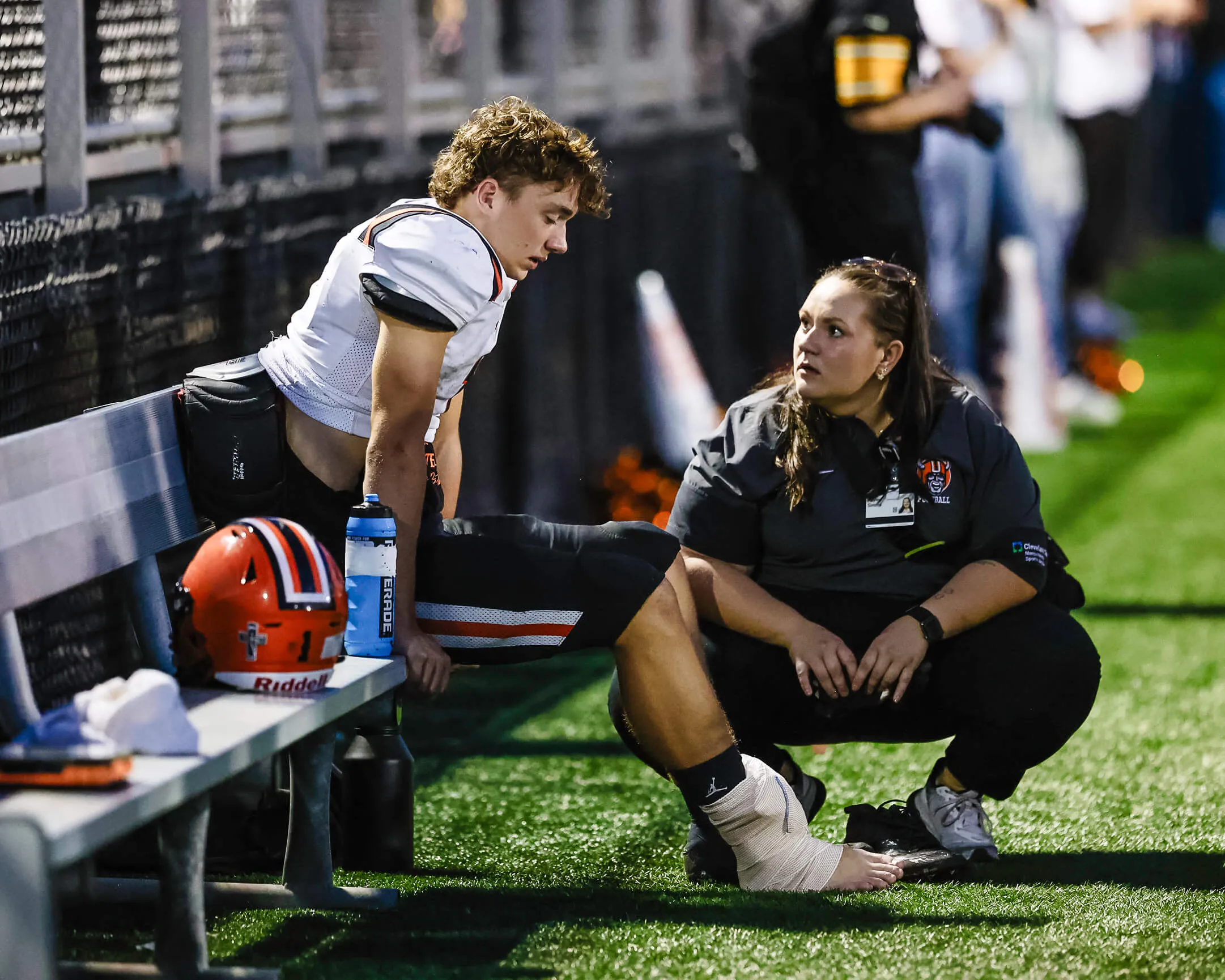
Every beginner asks it. Where do I start in photography? Sounds like a question about cameras. About settings. About which lens to use. It isn’t any of those things. The moment this photo was taken, the ball was somewhere on the other side of the field. The starting quarterback was on the bench. With the closed eyes of a player who knows his night, and possibly season, is probably over. The two students shadowing me that night almost missed a good story, not because of cameras or settings but because the story changed.
The Moment
Last fall, I was covering a high school football rivalry game with a couple of students. In the first half, the starting quarterback went down. Big moment. Everyone on the sideline turned towards the backup warming up. My students looked at me and asked, “What do we shoot now?”
I said, “Come on.” And started walking the opposite direction.
The Miss
Most beginners assume photography is about pointing at the obvious thing. The action. The subject. Whatever everyone else is already looking at. So when the obvious thing disappears, they freeze. They don’t know where to continue because nobody told them the story could change in an instant.
The camera doesn’t tell you what to shoot. You do. And that means you have to know what you’re actually looking for before you raise it.
Sometimes the real story doesn’t happen on the field.
The Photo Lab
The Lesson
I walked my students down the sideline, away from the play, to a spot far enough from the bench that we wouldn’t be noticed. The senior quarterback was sitting there, ankle wrapped by the trainer kneeling beside him. Nobody was pointing a camera at the bench. Everyone was watching the backup take his first snaps.
I pointed at the scene and said nothing. They already knew and had their cameras up. After the game we debriefed about where good stories might be when you think through what just happened, and how you cover the whole story. Those changes can happen anywhere, not just in sports.
That’s where photography starts. Not with a setting. A camera. A lens. It’s not the tools, it’s a photographer’s mindset that always begins with a question: what’s actually happening here? What’s the story? What’s the result? When you train yourself to ask those questions before you raise the camera, you stop chasing the obvious frame. You start finding real images with context and emotion. And, the bonus is you cover both sides of the story, which for event coverage is required.
The Lab
Every scene has an original story and a background story. The original is what everyone sees. The background is what photographers find. Your job isn’t to document the obvious. It’s to read the room, notice what’s happening at the edges, and decide what’s actually worth capturing.
That decision happens before the camera comes up. You’re not reacting. You’re anticipating. You’re thinking. You’re asking, where is the real moment in this scene, and am I in the right position to capture it?
Beginners think photographers are fast. The good ones are actually slow. They’re watching longer, moving deliberately, waiting for the moment that most people miss because they were already shooting something else.
Try This
Go somewhere with people. A game, a family gathering, a school event. Don’t shoot the obvious original story. Find the margin. The bench. The sideline. The parent watching from the fence. The family table laughing. The kid waiting for their turn on the diving board. Spend fifteen minutes shooting only the edges, the background, of the scene and see what you come back with. That’s where the stories are.
Why It Matters
After the game, I wrote a note to the player’s mother, who had hired me to cover other events in the past. I shared the images and explained what I saw in that moment. I wanted her to know the photos existed, and I wanted her permission before doing anything with them. That’s part of it too. Finding the story is one thing. Handling it with care is another.
Photography starts the same place every time. You ask what’s really happening. You move toward it. You raise the camera when you’re ready, not before.
That’s the starting point. It works every time.
Trust it. Trust yourself.
- TMac #shooton
